How Do Newly Promoted Clubs Survive In The EPL?

Part 2: The Four Survival KPIs
The first part of this two-part consideration of the prospects of newly promoted clubs surviving in the English Premier League (EPL) concluded that the lower survival rate in recent seasons was due to poorer defensive records rather than any systematic reduction in wage expenditure relative to other EPL clubs. It was also suggested that there might be a Moneyball-type inefficiency with newly promoted teams possibly allocating too large a proportion of their wage budget to over-valued strikers when more priority should be given to improving defensive effectiveness. In this post, the focus is on identifying four key performance indicators (KPIs) for newly promoted clubs that I will call the “survival KPIs”. These survival KPIs are then combined using a logistic regression model to determine the current survival probabilities of Burnley, Leeds United and Sunderland in the EPL this season.

The Four Survival KPIs

The four survival KPIs are based on four requirements for a newly promoted club:

  • Squad quality measured as wage expenditure relative to the EPL median
  • Impetus created by a strong start to the season measured by points per game in the first half of the season
  • Attacking effectiveness measured by goals scored per game
  • Defensive effectiveness measured by goals conceded per game

Using data on the 89 newly promoted clubs in the EPL from seasons 1995/96 – 2024/25, these clubs have been allocated to four quartiles for each survival KPI. Table 1 sets out the range of values for each quartile, with Q1 as the quartile most likely to survive through to Q4 as the quartile most likely to be relegated. Table 2 reports the relegation probabilities for each quartile for each KPI. So, for example, as regards squad quality, Table 1 shows that the top quartile (Q1) of newly promoted clubs had wage costs at least 79.5% of the EPL median that season. Table 2 shows that only 22.7% of these clubs were relegated. In contrast, the clubs in the lowest quartile (Q4) had wage costs less than 55% of the EPL median that season and 77.3% of these clubs were relegated.

Table 1: Survival KPIs, Newly Promoted Clubs in the EPL, 1995/96 – 2024/25

Table 2: Relegation Probabilities, Newly Promoted Clubs in the EPL, 1995/96 – 2024/25

The standout result is the low relegation probability for newly promoted clubs in Q1 for the Impetus KPI. Only 8% of newly promoted clubs with an average of 1.21 points per game or better in the first half of the season have been relegated. This equates to 23+ points after 19 games. Only 17 newly promoted clubs have achieved 23+ points by mid-season in the 30 seasons since 1995 and only two have done so in the last five seasons – Fulham in 2022/23 with 31 points and the Bielsa-led Leeds United with 26 points in 2020/21.

It should be noted that there is little difference in the relegation probabilities between Q2 and Q3, the mid-range values for both Squad Quality and Attacking Effectiveness, suggesting that marginal improvements in both of these KPIs have little impact for most clubs. As regards defensive effectiveness, both Q1 and Q2 have low relegation quartiles suggesting that the crucial benchmark is limiting goals conceded to under 1.61 goals per game (or 62 goals conceded over the entire season). Of the 43 newly promoted clubs that have done so since 1995, only seven have been relegated, a relegation probability of 16.3%. Reinforcing the main conclusion from the previous post that the main reason that for the poor performance of newly promoted clubs in recent seasons, only four clubs have conceded fewer than 62 goals in the last five seasons – Fulham (53 goals conceded, 2020/21), Leeds United (54 goals conceded, 2020/21); Brentford (56 goals conceded, 2021/22) and Fulham (53 goals conceded, 2022/23) – with of these four clubs, only Fulham being relegated in 2020/21 (primarily due to their poor attacking effectiveness).

Where Did The Newly Promoted Clubs Go Wrong Last Season?

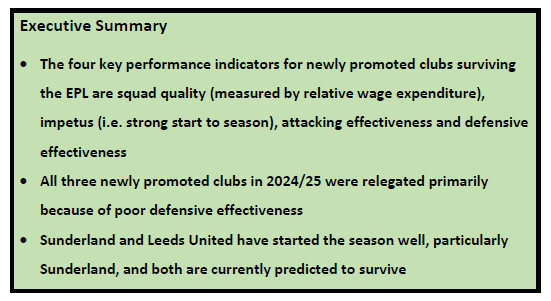
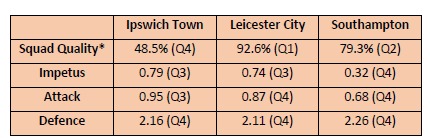
Just as in the previous season 2023/24, so too last season, all three newly promoted clubs – Ipswich Town, Leicester City and Southampton – were relegated. Table 3 reports the survival KPIs for these clubs. In the case of Ipswich Town, their Squad Quality was low with relative expenditure under 50% of the EPL median. In contrast Leicester City spent close to the EPL median and Southampton were just marginally under the Q1 threshold. The Achilles Heel for all three clubs was their very poor defensive effectiveness, conceding goals at a rate of over two goals per game. Only 11 newly promoted clubs have conceded 80+ goals since 1995; all have been relegated.

Table 3: Survival KPIs, Newly Promoted Clubs in the EPL, 2024/25
*Calculated using estimated squad salary costs sourced from Capology (www.capology.com)

What About This Season?

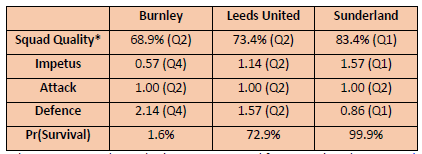
As I write, seven rounds of games have been completed in the EPL. Of the three newly promoted clubs, the most impressive start has been by Sunderland who are currently 9th in the EPL with 11 points which puts them in Q1 in terms of Impetus as does their Squad Quality with wage expenditure estimated at 83% of the EPL median, and their defensive effectiveness with only six goals conceded in their first seven games. Leeds United have also made a solid if somewhat less spectacular start with 8 points and ranking in Q2 for all four survival KPIs. Both Sunderland and Leeds United are better placed at this stage of the season than all three newly promoted clubs last season when Leicester City had 6 points, Ipswich Town 4 points and Southampton 1 point. Burnley have made the poorest start of the newly promoted clubs this season with only 4 points, matching Ipswich Town’s start last season but, unlike Ipswich Town, Burnley rank Q2 in both Squad Quality and Attack. Worryingly Burnley’s defensive effectiveness which was so crucial to their promotion from the Championship has been poor so far this season and, at over two goals conceded per game, on a par with Ipswich Town, Leicester City and Southampton last season.

Table 4: Survival KPIs and Survival Probabilities, Newly Promoted Clubs in the EPL, 2025/26, After Round 7
*Calculated using estimated squad salary costs sourced from Capology (www.capology.com)

Using the survival KPIs for all 86 newly promoted clubs 1995 – 2024, a logistic regression model has been estimated for the survival probabilities of newly promoted clubs in the EPL. This model combines the four survival KPIs and weights their relative importance based on their ability to jointly identify correctly those newly promoted clubs that will survival. The model has a success rate of 82.6% predicting which newly promoted clubs will survive and which will be relegated. Based on the first seven games, Sunderland have a survival probability of 99.9%, Leeds United 72.9% and Burnley 1.6%. These figures are extreme and merely highlight that Sunderland have made an exceptional start, Leeds United a good start and Burnley have struggled defensively. It is still early days and crucially the survival probabilities do not control for the quality of the opposition. Sunderland have yet to play a team in the top five whereas Leeds United and Burnley have both played three teams in the top five. I will update these survival probabilities regularly as the season progresses. They are likely to be quite volatile in the coming weeks but should become more stable and robust by late December.
How Do Newly Promoted Clubs Survive In The EPL? Part One: What Do The Numbers Say?

The English Premier League (EPL) started its 34th season last weekend with most of the pundits focusing on the top of the table and whether Arne Slot’s Liverpool can retain the title in the face of a rejuvenated challenge by Pep Guardiola’s Manchester City. Relatively little attention has been given to the chances of the newly promoted clubs – Leeds United, Burnley and Sunderland – avoiding relegation with most pundits tipping all three to follow their predecessors in the last two seasons in being immediately relegated back to the Championship. The opening weekend of the EPL season went somewhat against the doom merchants with two of the three newly promoted clubs, Sunderland and Leeds United, winning. This is the first time that two newly promoted clubs have won their first game since Brentford and Watford in 2021/22 with the only other instance of this rare feat being Bolton Wanderers and Crystal Palace in 1997/98 although it should be noted that only Brentford then went on to avoid relegation. I must of course in the interests of objectivity declare my allegiances – I have lived and worked in Leeds for over 40 years and, as a Scot growing up in the 1960s, my “English” team was always Leeds United, then packed with Scottish internationals with Billy Bremner and Eddie Gray my particular favourites. So with Leeds United returning to the EPL after two seasons in the Championship, what are the chances that Leeds United and the other two promoted clubs can defy conventional wisdom and avoid relegation? What do the numbers say?

The Dataset

The dataset used in the analysis covers 30 years of the EPL from season 1995/96 to season 2025/26. The analysis has begun in 1995/96 which was the first season that the EPL adopted its current structure of 20 clubs with three clubs relegated. Note that there were only two teams promoted from the Championship in 1995/96. League performance has been measured by Wins, Draws, Losses, Goals For, Goals Against and League Points. In order to focus on sporting performance, League Points are calculated solely on the basis of games won and drawn, and exclude any points deductions for regulatory breaches. There is no case of any club being relegated solely because of regulatory breaches. Survival Rate is defined as the percentage of newly promoted clubs that were not relegated in their first season in the EPL. Relative Wages has been calculated as the total wage expenditure of clubs as reported in their company accounts relative to the median wage expenditure of all EPL clubs that season (indexed such that 100 = median wage expenditure). This allows comparisons to be drawn across seasons despite the underlying upward trend in wage expenditure. Company accounts are not yet available for 2024/25 so there is no analysis of wage expenditure and sporting efficiency in the most recent EPL season. Total wage expenditure includes all wage expenditure not just player wages. Estimates of individual player wages and total squad costs are available but their accuracy is unknown and limited to recent seasons only. A comparison of one such set of estimated squad wage costs and the wage expenditures reported in company accounts for the period 2014 – 2024 yielded a correlation coefficient of 0.933 which suggests that the “official” wage expenditures provide a very good proxy for player wage costs. Sporting Efficiency is defined as League Points divided by Relative Wages (and multiplied by 100). Sporting Efficiency is a standardised measured of league points per unit of wage expenditure across seasons that attempts to capture the ability of clubs to transform financial expenditure into sporting performance which, when all is said and done, is the fundamental transformation in professional team sports and at the heart of the Moneyball story as to how teams can attempt to offset limited financial resources by greater sporting efficiency.

League Performance of Newly Promoted Clubs

Table 1 summarises the average league performance of newly promoted clubs over the last 30 seasons of the EPL, broken down into 5-year sub-periods in order to detect any long-term trends over time. In addition, the proposition that the average league performance has deteriorated in the last five seasons compared to the previous 25 seasons has been formally tested statistically using a t-test with instances of strong evidence (i.e. statistical significance) of this deterioration indicated by asterisks (or a question mark when is marginally weaker). The key points to emerge are:

  1. There is no clear trend in wins, draws and losses by newly promoted clubs between 1995/96 and 2019/20 but thereafter there is strong evidence that newly promoted clubs are winning and drawing fewer games and, by implication, losing more games.
  2. Newly promoted clubs averaged 4 more losses since 2020 compared to previous seasons with an average of 22.5 losses in the last five seasons as opposed to an average of 18.7 losses in previous 25 seasons.
  3. The poorer league performance in recent seasons represents a reduction in average league points from 39.0 (1995/96 – 2019/20) to 30.5 points (2020/21 – 2024/25).
  4. Given that the acknowledged benchmark to avoid relegation is 40 points, not surprisingly the survival rate of newly promoted clubs has declined in the last five seasons to only a one-in-three chance of survival (33.3%) compared to a slightly better than one-in-two chance (56.8%) in the previous 25 seasons.
  5. The data suggests strongly that the primary reason for the decline in league performance and survival rates of newly promoted clubs in the last five seasons has been weaker defensive play, not weaker attacking play. Newly promoted clubs averaged 61.1 goals against in seasons 1995/96 – 2019/20 but this rose to 73.8 goals against in the last five seasons which represents very strong evidence of a systematic change in the defensive effectiveness of newly promoted clubs. In stark contrast, the change in goals for has been negligible with a decline from 40.5 (1995/96 – 2019/20) to 38.8 (2020/21 – 2024/25) which is more likely to be accounted for by season-to-season fluctuation rather than any underlying systematic decline in attacking effectiveness.

Wage Costs and Sporting Efficiency of Newly Promoted Clubs

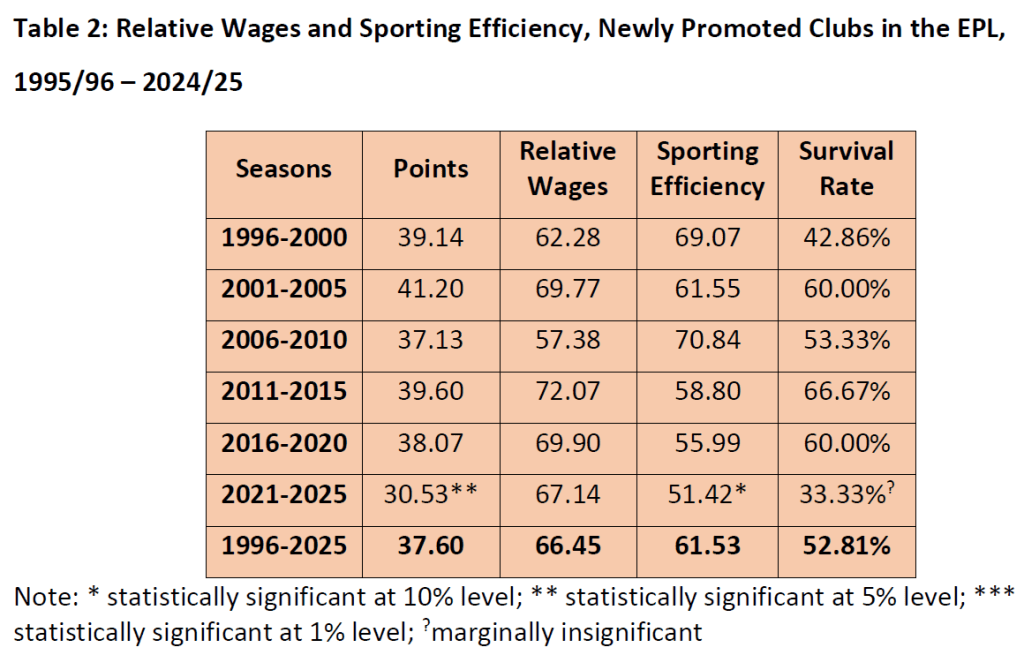
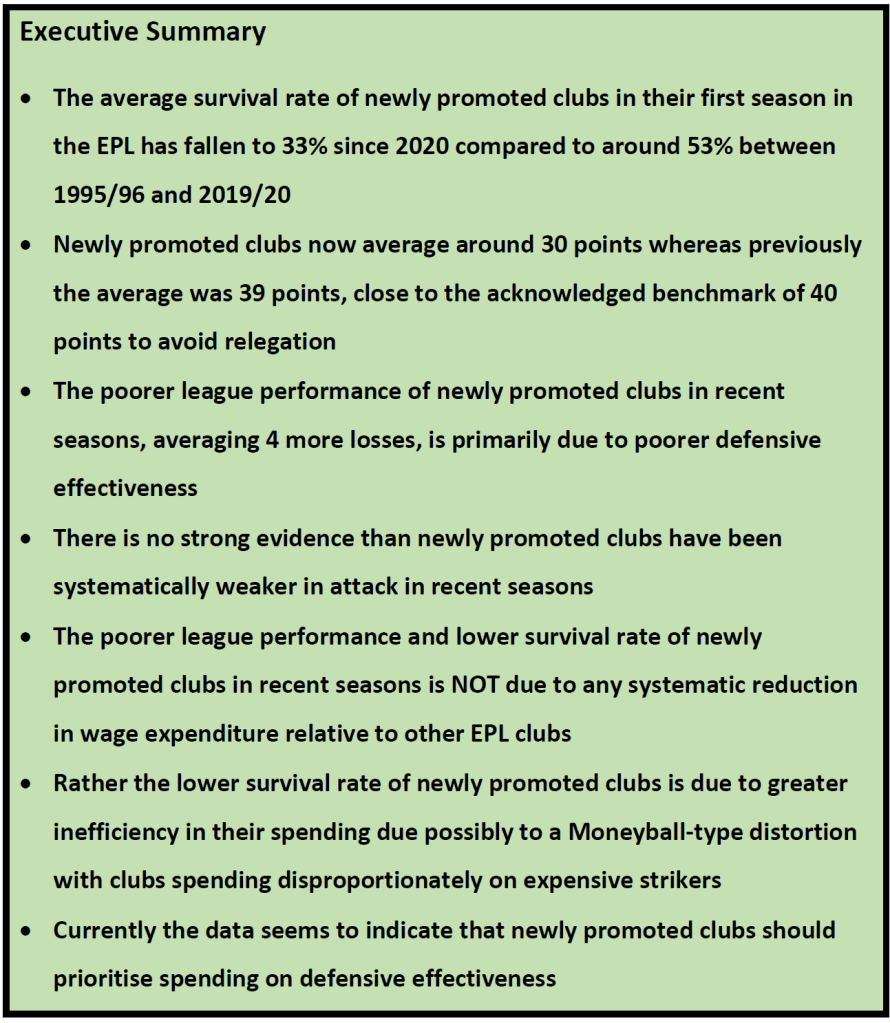
It has been frequently argued that the recent decline in the league performance and survival rates of newly promoted clubs is due to an increasing gap in financial resources between established EPL clubs and the newly promoted clubs. Table 2 addresses this issue. There is absolutely no support for newly promoted clubs being more financially disadvantaged relatively compared to their predecessors. There has been virtually no change in the relative wage expenditure of newly promoted clubs in the last five seasons which has averaged 67.1 compared to 66.3 in the previous 25 seasons. The lower survival rate in recent seasons is NOT due to newly promoted clubs spending proportionately less on playing talent.

There is a very simply equation that holds by definition:

League Performance = Relative Wages X Sporting Efficiency

Since their league performance has declined but the relative wage expenditure of newly promoted clubs has stayed more or less constant, then their sporting efficiency MUST have declined. Table 2 suggests that there may have been a downward trend in the sporting efficiency in newly promoted clubs in the last 15 seasons. In addition, there is strong evidence that there has been a systematic downward shift in the sporting efficiency in the last five seasons to 51.4 compared to the previous average of 63.2 (1995/96 – 2019/20). On its own, this is merely a statement of the obvious dressed up in mathematical and statistical formalism. Newly promoted clubs are performing worse on the pitch as a result of spending less effectively. The crucial question is why league performance and sporting efficiency have declined. The answer may lie in reflecting on the fact that, as we discovered in Table 1, the reason for the poorer league performance is primarily due to poorer defensive effectiveness not poorer attacking effectiveness. Newly promoted clubs seem to be buying the same number of goals scored with the same relative wage budget as in previous seasons but at the cost of buying less defensive effectiveness and conceding more goals. This is consistent with a Moneyball-type distortion in the EPL player market with a premium paid for strikers that may not be fully warranted by current tactical developments in the game. The numbers would support newly promoted clubs giving a higher priority to defensive effectiveness in their recruitment and retention policy and avoiding spending excessively on expensive strikers, particularly those with little experience of playing and scoring in the top leagues.

Financial Determinism and the Shooting-Star Phenomenon in the English Premier League

Executive Summary

  • Financial determinism in professional team sports refers to those leagues in which sporting performance is largely determined by expenditure on playing talent
  • Financial determinism creates the “shooting-star” phenomenon – a small group of ”stars”, big-market teams with the high wage costs and high sporting performance, and a large “tail” of smaller-market teams with lower wage costs and lower sporting performance
  • There is a very high degree of financial determinism in the English Premier League
  • Achieving high sporting efficiency is critical for small-market teams with limited wage budgets seeking to avoid relegation

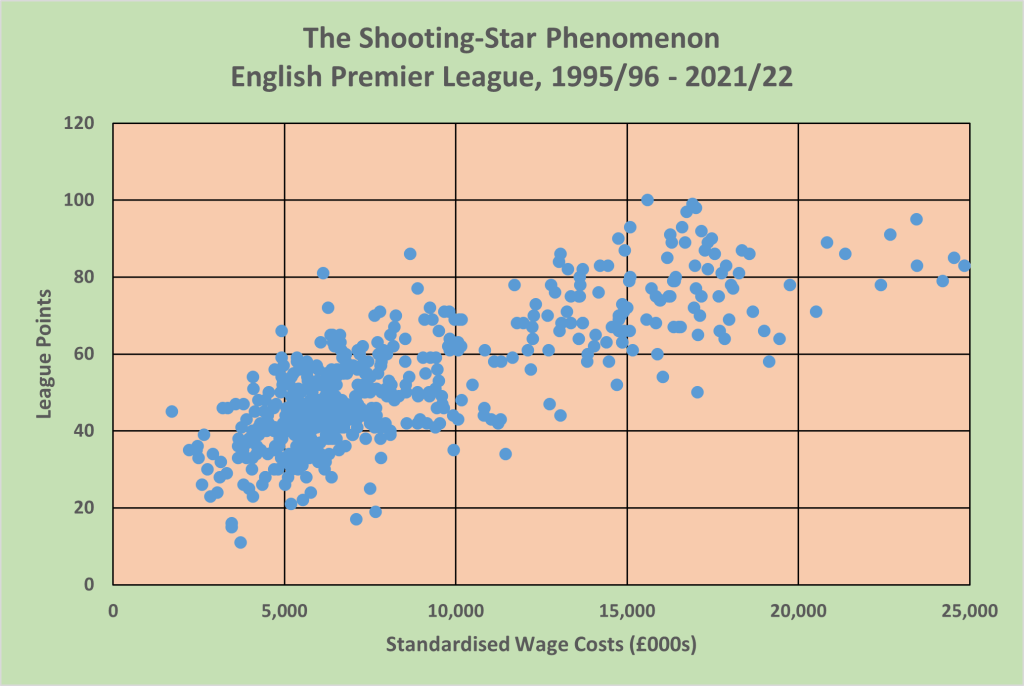
Financial determinism in professional team sports refers to those leagues in which sporting performance is largely determined by expenditure on playing talent. It is the sporting “law of gravity”. Financial determinism implies a strong win-wage relationship with league outcomes highly correlated with wage costs so that those teams with the biggest markets and the greatest economic power (i.e. the biggest “wallets”) to be able to afford the best players tend to win. Financial determinism creates what can be called the “shooting-star” phenomenon shown in Figure 1. The “stars” are the sporting elite in any league, the big-market teams with the high wage costs and high sporting performance. The rest of the league constitutes the “tail”, the smaller-market teams with lower wage costs and lower sporting performance. Some small-market teams can temporarily defy the law of gravity by achieving high sporting efficiency. The classic example of this is the Moneyball story in Major League Baseball where the Oakland Athletics used data analytics to identify undervalued playing talent. And, of course, there are the bigger market teams who spend big but do so inefficiently and perform well below expectation.

Figure 1: The Shooting-Star Phenomenon

A fundamental proposition in sports economics is that uncertainty of outcome is a necessary condition for viable professional sports leagues. This is the notion that the essential characteristic of sport is the excitement of unscripted drama where the outcome is determined by the contest and is not scripted in advance. Uncertainty of outcome requires that teams in any league are relatively equally matched in their economic power with similar revenues and similar access to financial capital. Unequal distribution of economic power across teams leads to financial determinism. The most common causes of disparities in economic power between teams are location (i.e. teams based in large metropolitan areas often have much bigger fanbases and, consequently, can generate much higher revenues) and ownership wealth (i.e. teams with rich owners who are driven by sporting glory rather than profit and will spend whatever it takes to win). To prevent financial determinism, leagues have used a number of regulatory mechanisms to maintain competitive balance including revenue sharing, salary caps and player drafts.

Is the English Premier League subject to financial determinism and the shooting-star phenomenon? To answer this question I have tracked wage costs reported in club accounts from 1995/96 onwards when the English Premier League adopted its current structure of 20 teams and 380 games with three teams relegated. Clubs are still in the process of reporting their 2023 accounts so that the analysis concludes with season 2021/22. Since the analysis covers 27 seasons, wage costs need to be standardised to allow for wage inflation. I have used average wage costs each season to deflate wage costs to 1995/96 levels.  Very roughly, £10m wage costs in 1996/97 equates to £200m wage costs in 2021/22. Sporting performance has been measured by league points based on match outcomes; any point deductions for breach of league regulations have been excluded. (Middlesbrough were deducted 3 points in 1996/97 for failing to fulfil a scheduled fixture and Portsmouth were deducted 9 points in 2009/10 for going into administration.) Figure 2 shows the scatterplot of league points and standardised wage costs. The two groupings, the big-spending stars and the lower-spending tail, are very obvious. The tail is very dense and contains most of the observations (73.9% of the clubs had standardised wage costs under £10m). The stars are fewer in number and more dispersed with 10 instances of clubs having standardised wage costs in excess of £20m (which equates to over £400m in 2021/22). The correlation between standardised wage costs and league points is 0.793 which implies that over the 27 seasons, 62.8% of the variation in league performance can be explained by the variation in wage costs. In other words, there is a very high degree of financial determinism in the English Premier League.

Figure 2: The Shooting-Star Phenomenon in the English Premier League

Season 2021/22 is very typical as regards the degree of financial determinism in the English Premier League as shown in Figure 3. The correlation between wage costs and league points is 0.793 which implies that 61.2% of the variation in league performance can be explained by the variation in wage costs. The linear trendline acts as a performance benchmark – the average efficient outcome for any given level of wage costs – and thus identifies above-average efficient (“above the line”) outcomes and below-average efficient, “below the line” outcomes. At the top end, Manchester City, the champions with 93 points, a single point ahead of Liverpool, were outspent by both Manchester United and Liverpool. Manchester United were highly inefficient gaining only 58 points but with wage costs of £408m. By comparison, West Ham United gained 56 points with wage costs of £136m.

Figure 3: Win-Wage Relationship in English Premier League, 2021/22

As regards relegation, all three relegated teams – Norwich City, Watford and Burnley – lie below the average-efficiency line. In the cases of both Burnley and Watford their final league positions matched their wage rank  – their sporting efficiency was not good enough to offset their resource disadvantage. In contrast, Norwich City allocated enough resource to avoid relegation – their wage costs of £117m ranked 15th – but they were highly inefficient. Of the lower spending teams, the two most efficient teams were Brentford and Brighton and Hove Albion who both finished safely in mid-table but ranked 20th and 16th, respectively, in wage costs. In a future post, I will analyse the determinants of sporting efficiency in more detail.

Read other Related Posts

League Gate Attendances in English Football: A Historical Perspective

Executive Summary

  • The historical trends in league gate attendances in English football can be powerfully summarised visually using timeplots
  • Total league attendances peaked in 1948/49 and thereafter declined until the mid-1980s
  • League attendances across the Premier League and Football League have recovered dramatically since the mid-1980s and are now at levels last experienced in the 1950s
  • Using average gates to allow for changes in the number of clubs and matches, the  Premiership matches in 2022/23 averaged 40,229 spectators per match, the highest average gate in the top division since the formation of the Football League in 1888 

How popular are the top four tiers of English league football as a spectator sport from a historical perspective? That’s the question that I want to address in this post using timeplots to visualise the historical trends in gate attendances. I have compiled a dataset with total league attendances for every season since the Football League began in 1888. To ensure as much comparability as possible, I have included only regular-season matches and excluded post-season play-off matches. (A historical footnote – post-season playoffs to decide promotion/relegation are not a modern innovation. There were playoffs called “test matches” in the early years of the Football League after the creation of the Second Division in 1892 but these were abandoned in 1898 and replaced by automatic promotion and relegation following  a scandal when Stoke City and Burnley played out a convenient goalless draw that ensured both would be promoted.)

Total league attendances for the top four divisions are plotted in Figure 1 with three breaks: 1915/16 – 1918/19 due to the First World War, 1939/40 – 1945/46 due to the Second World War and 2020/21 due to the Covid pandemic when all matches were played behind closed doors. In addition, total attendances dropped sharply in 2019/20 due to the final part of the season being postponed and the matches eventually played behind closed doors in the case of the Premier League and Championship, and cancelled entirely in League One and League Two.

Figure 1: Total League Attendances (Regular Season), England, 1888-2023

The Football League started in 1888 with a single division of 12 clubs. Preston North End were the original “Invincibles”, completing the League and FA Cup “Double” unbeaten in the inaugural season. A second division was formed in 1892 and membership of the Football League gradually expanded so that by the outbreak of the First World War in 1914 there were 40 member clubs split equally into two divisions with automatic promotion and relegation between the two divisions. Gate attendances peaked at 12.5 million in the 1913/14 season. The Football League expanded rapidly in the years immediately after the First World War with the incorporation of the Southern League as Division 3 in 1920 and the creation of a Division 3 (North) and Division 3 (South) the following years which increased the membership to 88 clubs by 1923. Total gate attendances reached 27.9 million in season 1937/38.

Gate attendances sharply increased after the Second World War, reaching a record 41.3 million in season 1948/49 which equated to around one million fans attending Football League matches on Saturday afternoons. Although the Football League expanded its membership to its current level of 92 clubs in 1950 and reorganised the two regionalised divisions into Division 3 and Division 4 in 1958, a long-term decline in attendances had set in with attendances falling steadily from the 1950s until the mid-1980s with the exception of a brief reversal of fortune in the late 1960s attributed to a renewed love of the beautiful game after England’s 1966 World Cup victory. The decline bottomed out in 1985/86 when Football League attendances fell to only 16.5 million which represented a 60.0% decrease from the peak in 1948/49. Thereafter the story has been one of continued growth, accelerated in part by the declaration of independence of the top division in 1992 with the formation of the FA Premier League. By last season (2022/23), league attendances in the top four tiers of English football had reached 34.8 million, a level last attained in season 1954/55 – quite an incredible turnaround.

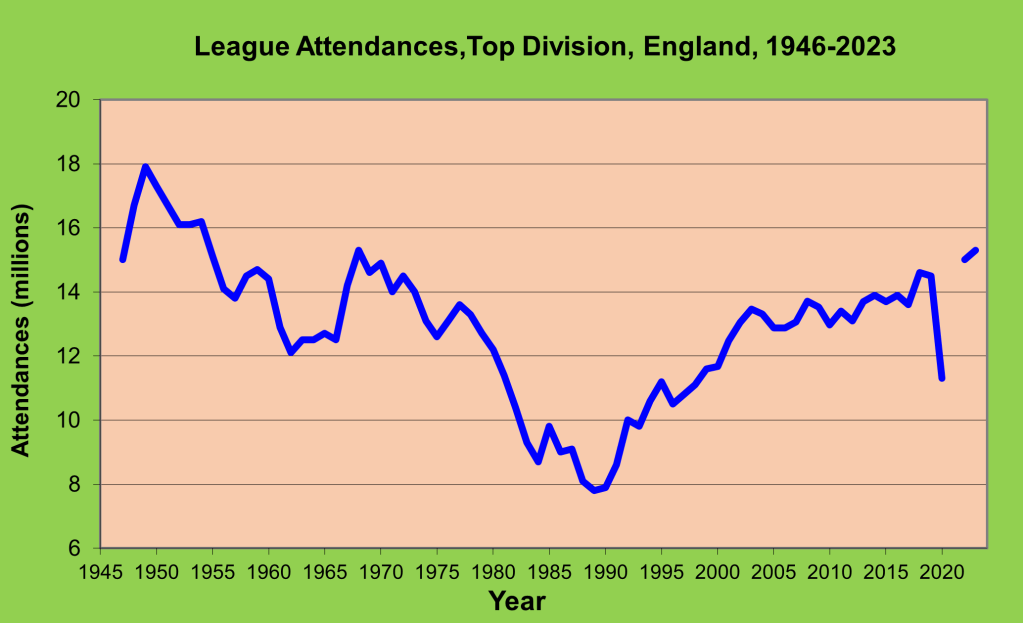
The U-shaped pattern in total league attendances since the end of the Second World War is also evident but less clearly so if we focus only on the top division (see Figure 2). In particular, the post-1966 World Cup effect is much more noticeable with attendances rising from 12.5 million in 1965/66 to 15.3 million in 1967/68 and remaining above 14 million until 1973/74, and thereafter declining to a low of 7.8 million in 1988/89. Interestingly, given that league attendances in the top division account for 40% – 50% of total attendances for the top four divisions, it is somewhat anomalous that the recovery in attendances in the top division seems to have lagged around three years behind the rest of the Football League. However, part of the explanation is the changes in the number of clubs in the top division during that period. There were 22 clubs in the top division from 1919/20 to 1986/87 but this was reduced to 21 clubs in 1987/88 and 20 clubs in 1988/89 before returning to 22 clubs in 1991/92 with the current divisional structure of a 20-club Premier League and three 24-club divisions in the Football League dating from 1995.

Figure 2: League Attendances, Top Division, England, 1946-2023

Given the variations in the number of matches with spectators in the top division across time due to the changes in the number of clubs as well as the effects of the pandemic on total attendances in the 2019/20 season, it is more useful to compare average league gates (see Figure 3). The average gate at top division matches peaked at 38,776 in 1948/49 and declined to a low of 18,856 in 1983/84 (which leads the nadir of total Football League attendances by two years). The rapid growth in Premier League attendances occurred between 1993 and 2003 with the average gate of 21,125 in 1992/93, the first season of the Premier League, increasing by 67.8% over the next 10 years to an average gate of 35,445 in 2002/03. Growth has continued thereafter so that the average gate in the Premier League reached 40,229 in 2022/23, an historical high since the formation of the Football League and 3.7% above the previous record average gate set in 1948/49.

So to answer the question I posed at the start of the post – the top tier of English league football has never been more popular as measured by gate attendances on a per match basis, and the rest of the Football League has a level of popularity not experienced since the 1950s. England has rediscovered its love of the beautiful game since the mid-1980s and not just Premiership football. And that is before considering the explosive growth in TV coverage of English league football both domestically and internationally. But that, as they say, is another ball game entirely.

Figure 3: Average Gate, Top Division, England, 1946-2023