Football, Finance and Fans in the European Big Five

Executive Summary

  •  Divergent revenue growth paths in the Big Five European football leagues since 1996 has more than doubled the inequality in the financial strength of these leagues.
  • The financial dominance of the EPL is based on growing gate attendances, increasing value of media rights and high marketing efficiency.
  • The financial dominance of the EPL puts it at a massive advantage in attracting the best sporting talent.
  • The pandemic highlighted the precarious financial position of the French and Italian leagues due to high wage-revenue ratios and consequent operating losses
  • The financial regulation of the Bundesliga clubs put them in a much stronger position to cope with loss of revenues during the pandemic.

The top tiers of the domestic football leagues in England, France, Germany, Italy and Spain constitute the so-called “Big Five” of European football in financial terms as measured by the total revenues of their member clubs. Figure 1 shows the growth in revenues in the Big Five since 1996. The most striking feature of this timeplot is the divergent growth paths of the Big Five. From a starting point of relative parity in 1996 the divergent growth paths of the Big Five call into question whether it is even appropriate to still talk in terms of the Big Five. Using the coefficient of variation (CoV) as a measure of relative dispersion (effectively CoV is just a standardised standard deviation with the scale effect removed), the degree of dispersion between the revenues of the Big Five has more than doubled from 0.244 in 1996 to 0.509 in 2022. The English Premier League (EPL) is quite literally in a league of its own in financial terms with total revenues of €6.4bn in 2022. The rest of the Big Five lag a long way behind with the Spanish La Liga and German Bundesliga grossing revenues of €3.3bn and €3.1bn, respectively in 2022 and the Italian Serie A and French Ligue 1 lagging another €1bn or so behind with revenues of €2.4bn and €2.0bn, respectively. And with the expected uplift in the EPL’s next media rights deal and the continued growth in gate attendances, the gap between the EPL and the rest of the Big Five looks set to increase further.
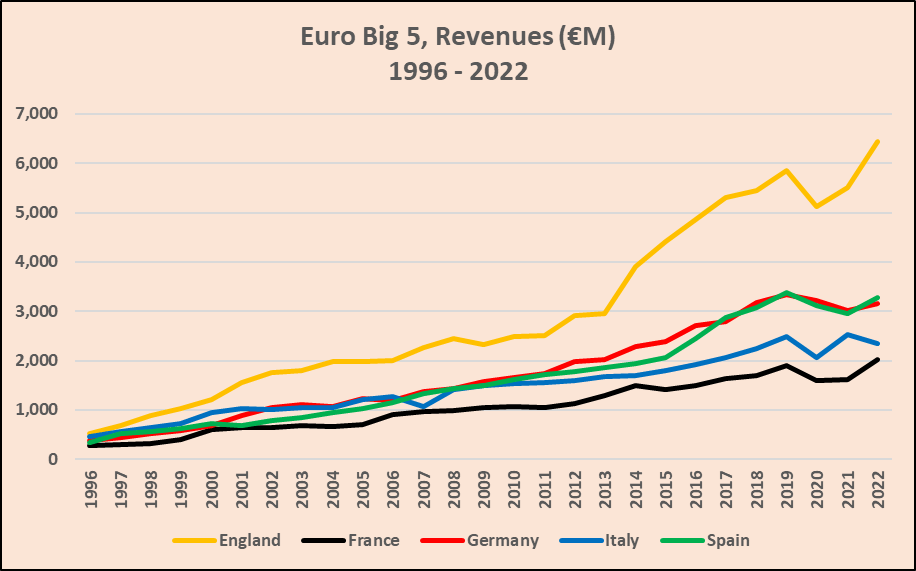
Figure 1: Revenues (m), European Big Five, 1996 – 2022

Another key feature of Figure 1 is the impact of the Covid pandemic on league revenues. The biggest losers in 2020 were the EPL clubs with the postponement of the last part of the 2019/20 leading to an overall loss of revenue of around €0.7bn. But although the whole of the 2020/21 season was played behind closed doors wiping out matchday revenues, media revenues increased with all games shown live. By 2022 with the return of spectators to football grounds and continued growth in media revenues, the EPL was back on its pre-pandemic trend with revenues over 10% higher than in 2019 prior to the pandemic. In contrast, of the other Big Five, only the French Ligue 1 had increased revenues in 2022 above the pre-pandemic level.

In assessing the revenue performance of football leagues/clubs, apart from revenue growth rates, there are two very useful revenue KPIs (Key Performance Indicators):

Media% = media revenues as a % of total revenues; and

Local Spend = non-media revenues per capita (using average league gate attendances as the size measure to standardise club/league revenues)

Media% shows the dependency of the league and its clubs on the value of their media rights. Local Spend is a measure of the marketing efficiency of clubs in generating matchday and commercial revenues relative to the size of their active fanbase as measured by average league gate attendance. As can be seen in Table 1 which reports these two revenue KPIs for 2019, 2021 and 2022, all the Big Five became much more dependent on media revenues during the Covid years as seen in the increased Media% in 2021. As would be expected Local Spend fell sharply in the Covid years with the loss of matchday revenues. What is more concerning in the longer term for the rest of the Big Five is that the financial strength of the EPL is based not only on the much higher value of their media rights but also the stronger capability of EPL clubs to generate matchday revenues and commercial revenues. Prior to the pandemic only the Spanish La Liga got close to the EPL in terms of Local Spend but by 2022 the EPL had a substantial lead over all of the other Big Five in Local Spend. Given as noted earlier, the underlying upward trends in gate attendances and the value of media rights in the EPL, when you also allow for the marketing efficiency advantage as measured by Local Spend, the financial dominance of the EPL seems likely to grow unabated in the coming years.

Table 1: Revenue KPIs, European Big Five, Selected Years

LeagueMedia%Local Spend (€)
201920212022201920212022
England59.12%68.66%54.14%3,1312,1893,732
France47.37%51.80%35.98%2,1921,7272,879
Germany44.33%55.21%43.82%2,1431,6462,164
Italy58.52%69.92%56.94%2,0491,3831,842
Spain54.25%67.74%58.53%2,8711,6472,354

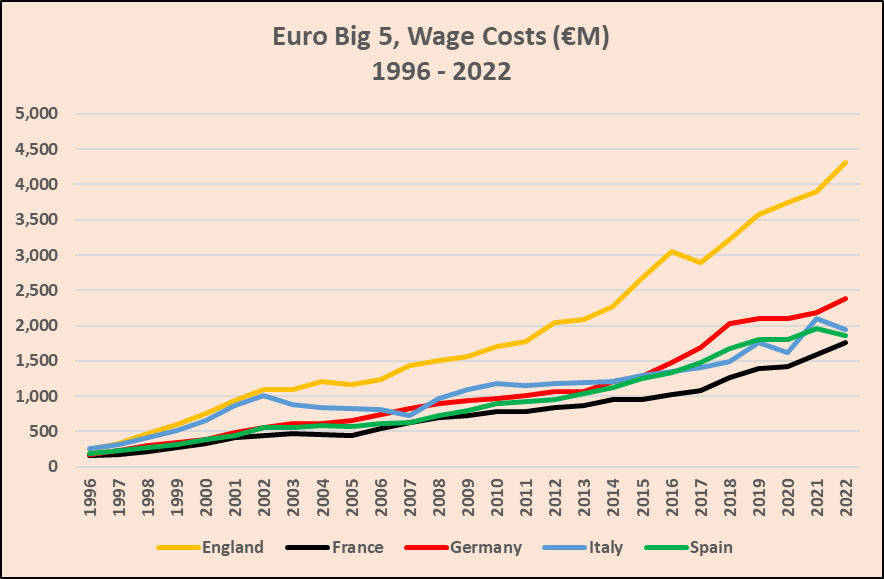
 The financial strength of the EPL allows their clubs to offer lucrative salaries and pay high transfer fees to attract the best players in the global football players’ labour market. As can be seen in Figure 2, the divergent revenue growth paths of the Big Five in Figure 1 are replicated in similar divergent wage growth paths. Effectively, the €3bn revenue advantage of the EPL in 2022 allowed EPL clubs to spend €2bn more on wage costs than the German Bundesliga, the next biggest spenders in the Big Five. And it is not just the best players that can be attracted to the EPL, it is also the best coaching and support staff. The danger of financial dominance in pro team sports is that it can lead to sporting dominance and this, in turn, can undermine the sustainability of the league as teams with less financial power seek to remain competitive by overspending on wages, leading to operating losses and increasing levels of debt.

Figure 2: Wage Costs (m), European Big Five, 1996 – 2022


The danger of overspending on wage costs relative to revenues can be seen very clearly in the wage-revenue ratio, possibly the most important financial performance ratio in pro team sports. By far the most dominant cost in any people business such as sport and entertainment is wages. If wage costs are too high relative to revenues, teams will make operating losses and will require to be either deficit-financed by their owners or debt-financed with all of the attendant risks. As can be seen in Figure 3, the wage-revenue ratios have tended to be highest in the French and Italian leagues, the smallest financially of the Big Five leagues. Indeed in the early 2000s the Italian Serie A got close to spending all of its revenue on wages, with the French Ligue 1 nearly emulating this during the Covid years.

Figure 3: Wage-Revenue Ratios, European Big Five, 1996 – 2022

Table 2 shows the danger of the financially smaller leagues having higher wage-revenue ratios. They can be put in a very precarious position if there is a sudden loss of revenues as happened during the pandemic (but could also happen if there is a loss in the value of a league’s media rights). Wage costs are largely fixed at any point in time through contractual commitments so any reduction in revenues is likely to lead to higher wage-revenue ratios and operating losses. As a benchmark, financial prudence would normally dictate wage-revenue under 65% in order to make operating profits. The French and Italian leagues operated with wage-revenue ratios above 70% prior to the pandemic and both remained above 80% in 2022. The Spanish La Liga was on a par with the EPL in 2019 at just over 60%. Both leagues saw their wage-revenue ratio rise above 70% in 2021 but, whereas the EPL fell back below 67% in 2022, La Liga remained high above 70%.

Table 2: Wage-Revenue Ratio, European Big Five, Selected Years

LeagueWage-Revenue Ratio
201920212022
England61.17%71.05%66.84%
France73.03%98.27%86.87%
Germany53.75%64.96%59.13%
Italy70.42%82.98%82.98%
Spain62.04%74.19%72.66%

In footballing terms, the bastion of football prudence has been the German Bundesliga with its longstanding financial management regime requiring clubs to submit budgets for approval as a condition of their league membership. As seen in both Figure 3 and Table 2, the Bundesliga has historically operated with wage-revenue ratios between 45% and 55%. Even with the loss of revenue during the Covid years, the wage-revenue ratio only hit 65% and fell back below 60% in 2022. The effectiveness of the German approach can be seen in Table 3 which reports the marginal wage-revenue ratio (MWRR) over the last 27 years. What this ratio shows is the proportion on average spent on wages of every increment of €1m of revenue over the last 27 years as each league has grown financially. The EPL has had a MWRR of 65.0% with the Spanish La Liga operating in a very similar way with a MWRR of 67.7%. The Bundesliga has had a MWRR of 56.5%. Given that the Spanish and German leagues are of a similar size in revenue terms, it suggests that long term the Germen financial management regime has lowered their wage-revenue ratio by 11% compared to what it would have been with a lighter touch. The very high MWRRs of the French and Italian leagues coupled with their lower revenue growth rates further reinforce the concerns over their financial future.

Table 3: Marginal Wage-Revenue Ratio, European Big Five, 1996 – 2022

LeagueMarginal Wage-Revenue Ratio 1996 – 2022
England65.03%
France83.21%
Germany56.60%
Italy79.31%
Spain67.73%

Notes:

  1. The raw financial data for the analysis has been sourced from various editions of Deloitte’s Annual Review of Football Finance (Annual Review of Football Finance 2023 | Deloitte Global)
  2. Throughout the years refer to financial year-end. Hence, for example, the figures reported for 1996 refer to season 1995/96.
  3. The base year of 1996 has been used since 1995/96 was the first season when the EPL adopted its current 20-club, 380-game format.
  4. Average league gates for season 2019/20 have been used to calculate Local Spend during the Covid years when games were played behind closed doors with no spectators in the stadia.

Financial Determinism and the Shooting-Star Phenomenon in the English Premier League

Executive Summary

  • Financial determinism in professional team sports refers to those leagues in which sporting performance is largely determined by expenditure on playing talent
  • Financial determinism creates the “shooting-star” phenomenon – a small group of ”stars”, big-market teams with the high wage costs and high sporting performance, and a large “tail” of smaller-market teams with lower wage costs and lower sporting performance
  • There is a very high degree of financial determinism in the English Premier League
  • Achieving high sporting efficiency is critical for small-market teams with limited wage budgets seeking to avoid relegation

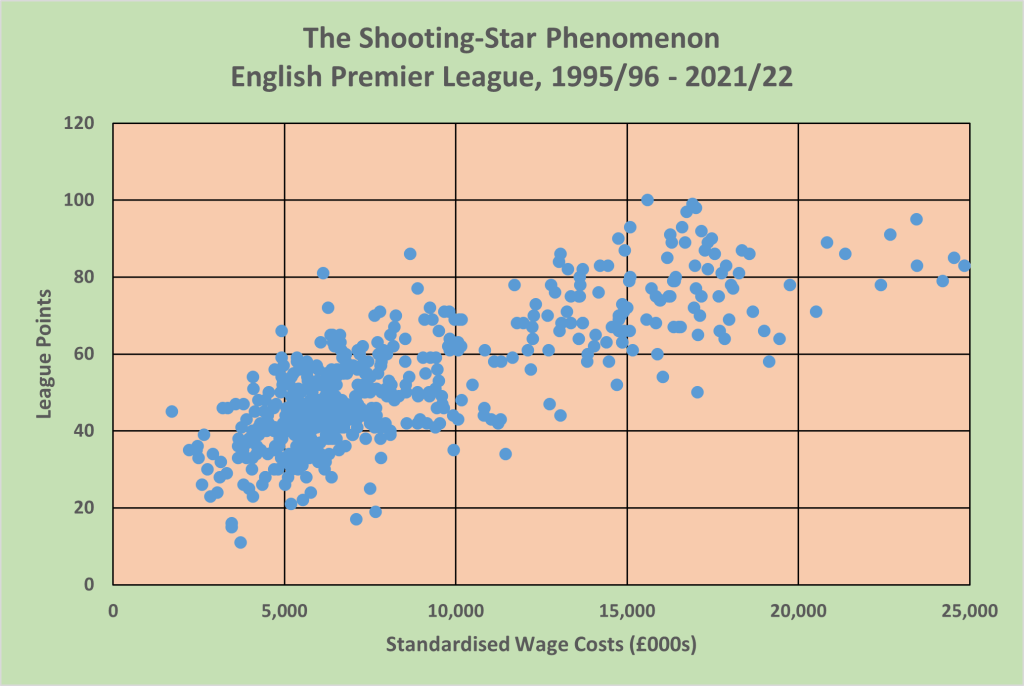
Financial determinism in professional team sports refers to those leagues in which sporting performance is largely determined by expenditure on playing talent. It is the sporting “law of gravity”. Financial determinism implies a strong win-wage relationship with league outcomes highly correlated with wage costs so that those teams with the biggest markets and the greatest economic power (i.e. the biggest “wallets”) to be able to afford the best players tend to win. Financial determinism creates what can be called the “shooting-star” phenomenon shown in Figure 1. The “stars” are the sporting elite in any league, the big-market teams with the high wage costs and high sporting performance. The rest of the league constitutes the “tail”, the smaller-market teams with lower wage costs and lower sporting performance. Some small-market teams can temporarily defy the law of gravity by achieving high sporting efficiency. The classic example of this is the Moneyball story in Major League Baseball where the Oakland Athletics used data analytics to identify undervalued playing talent. And, of course, there are the bigger market teams who spend big but do so inefficiently and perform well below expectation.

Figure 1: The Shooting-Star Phenomenon

A fundamental proposition in sports economics is that uncertainty of outcome is a necessary condition for viable professional sports leagues. This is the notion that the essential characteristic of sport is the excitement of unscripted drama where the outcome is determined by the contest and is not scripted in advance. Uncertainty of outcome requires that teams in any league are relatively equally matched in their economic power with similar revenues and similar access to financial capital. Unequal distribution of economic power across teams leads to financial determinism. The most common causes of disparities in economic power between teams are location (i.e. teams based in large metropolitan areas often have much bigger fanbases and, consequently, can generate much higher revenues) and ownership wealth (i.e. teams with rich owners who are driven by sporting glory rather than profit and will spend whatever it takes to win). To prevent financial determinism, leagues have used a number of regulatory mechanisms to maintain competitive balance including revenue sharing, salary caps and player drafts.

Is the English Premier League subject to financial determinism and the shooting-star phenomenon? To answer this question I have tracked wage costs reported in club accounts from 1995/96 onwards when the English Premier League adopted its current structure of 20 teams and 380 games with three teams relegated. Clubs are still in the process of reporting their 2023 accounts so that the analysis concludes with season 2021/22. Since the analysis covers 27 seasons, wage costs need to be standardised to allow for wage inflation. I have used average wage costs each season to deflate wage costs to 1995/96 levels.  Very roughly, £10m wage costs in 1996/97 equates to £200m wage costs in 2021/22. Sporting performance has been measured by league points based on match outcomes; any point deductions for breach of league regulations have been excluded. (Middlesbrough were deducted 3 points in 1996/97 for failing to fulfil a scheduled fixture and Portsmouth were deducted 9 points in 2009/10 for going into administration.) Figure 2 shows the scatterplot of league points and standardised wage costs. The two groupings, the big-spending stars and the lower-spending tail, are very obvious. The tail is very dense and contains most of the observations (73.9% of the clubs had standardised wage costs under £10m). The stars are fewer in number and more dispersed with 10 instances of clubs having standardised wage costs in excess of £20m (which equates to over £400m in 2021/22). The correlation between standardised wage costs and league points is 0.793 which implies that over the 27 seasons, 62.8% of the variation in league performance can be explained by the variation in wage costs. In other words, there is a very high degree of financial determinism in the English Premier League.

Figure 2: The Shooting-Star Phenomenon in the English Premier League

Season 2021/22 is very typical as regards the degree of financial determinism in the English Premier League as shown in Figure 3. The correlation between wage costs and league points is 0.793 which implies that 61.2% of the variation in league performance can be explained by the variation in wage costs. The linear trendline acts as a performance benchmark – the average efficient outcome for any given level of wage costs – and thus identifies above-average efficient (“above the line”) outcomes and below-average efficient, “below the line” outcomes. At the top end, Manchester City, the champions with 93 points, a single point ahead of Liverpool, were outspent by both Manchester United and Liverpool. Manchester United were highly inefficient gaining only 58 points but with wage costs of £408m. By comparison, West Ham United gained 56 points with wage costs of £136m.

Figure 3: Win-Wage Relationship in English Premier League, 2021/22

As regards relegation, all three relegated teams – Norwich City, Watford and Burnley – lie below the average-efficiency line. In the cases of both Burnley and Watford their final league positions matched their wage rank  – their sporting efficiency was not good enough to offset their resource disadvantage. In contrast, Norwich City allocated enough resource to avoid relegation – their wage costs of £117m ranked 15th – but they were highly inefficient. Of the lower spending teams, the two most efficient teams were Brentford and Brighton and Hove Albion who both finished safely in mid-table but ranked 20th and 16th, respectively, in wage costs. In a future post, I will analyse the determinants of sporting efficiency in more detail.

Read other Related Posts

The Dismal Science: A Personal Reflection – Part Three

Part 3: Great Expectations – Discovering the Meaning of Keynes

Executive Summary

  • I read Keynes’s General Theory initially for its understanding of the macroeconomic consequences of uncertainty, subsequently for its insights into economic methodology and how to conceptualise the capitalist economy, and more recently as an exemplar of a pragmatist impact theory.
  • The General Theory is an “impact theory” that seeks to change not only how we understand the world but, crucially, seeks to change how we intervene to improve the world and the everyday business of life.
  • What really counts in the interpretation of an impact text is not the authenticity of the interpretation but the effectiveness of its actionable insights.
  • I claim no privileged position in understanding Keynes but only that Keynes has a privileged position in the formation of my own understanding of how real-world economies behave.

I came to Keynes by a rather circuitous route. Despite being immersed in the Keynesian-Monetarist debates, I never read Keynes’s General Theory as an undergraduate. The attitude to Keynes seemed similar to that of the pioneering scientists in the natural sciences. You didn’t need to read Newton’s own words to understand the laws of motion which are set out so clearly in modern textbooks; so too with Keynes I was taught. My dis-satisfaction with mainstream economics and the search for alternatives initially led away from Keynes in two main directions – Karl Marx and Herbert Simon. A final-year option on Marxian economics gave me a proper grounding in classical economics from Smith to Marx as well as an introduction to radical literatures that paralleled what I was studying in more mainstream courses on macroeconomics and labour economics. Marxian theories of crisis provided a radical alternative to macroeconomics while Marxian analysis of the labour process gave a radically different conceptualisation to that provided by implicit contract theory, segmented and dual labour markets theories, and New Keynesian imperfectionist theories. The course on Marxian economics also introduced an alternative perspective on the methodology of economics that broadened my horizons beyond Popper and Kuhn.

I was actually introduced to the work of Herbert Simon in my first-year undergraduate course on International Relations. I had to write a paper on the Cuban Missile Crisis and given my growing interest in economics, my tutor suggested that I read Graham Allison’s Essence of Decision. It was this book that persuaded me to specialise in economics since it introduced alternatives to the rational-agent model, particularly Simon and the behavioural theories of the firm of Cyert and March.

By the time I arrived at Cambridge for my graduate studies in the early 1980s, my interest in a more behavioural approach to economics had led me to the problem of understanding decision making under conditions of uncertainty, and that in turn led to the work of George Shackle. It was Shackle’s The Years of High Theory that ultimately opened my eyes to the importance of reading, really reading, The General Theory. So from the outset I approached The General Theory influenced by Shackle and Joan Robinson with a focus on Chapter 12 and what Keynes had to say about long-term expectations. I was very fortunate at Cambridge to be taught macroeconomics by Geoff Harcourt and Bob Rowthorn, a great combination for someone strongly influenced by both radical Keynesian and Marxian critiques of mainstream economics. Both were wonderful role models – radical economists with a thorough knowledge of the history of the subject who combined excellent theoretical skills with a deep understanding of real-world economies, and a strong commitment to improving the lives of others.

The early 1980s was an exciting time to be in Cambridge. Rod O’Donnell was just finishing his PhD on the philosophical foundations of Keynes’s General Theory and attending one of his seminars made me realise the importance of Keynes’s Treatise on Probability. This was reinforced by Gay Meeks who taught the graduate course on Philosophical Issues in Economics. She, more than anyone, was the real starting point for what I call the “New Fundamentalist Keynesian” project of re-reading Keynes’s General Theory from the perspective of A Treatise on Probability. Gay’s paper, ‘Keynes on the rationality of decision procedures under uncertainty: the investment decision’, was first completed in 1976 and circulated around Cambridge for many years but only published in the early 1990s in her edited volume, Thoughtful Economic Man. (It was reconnecting with Gay Meeks and Geoff Harcourt in 2018 that more than anything convinced me to return to economics and that I still had something significant to contribute to the subject.)

The Cambridge-Australian influence on my thinking was strong – Geoff Harcourt and Rod O’Donnell as I have mentioned, but also Peter Kriesler whose work showed me the importance of Kalecki’s contribution. Another Australian I met at Cambridge was Murray Milgate but, unfortunately, I have to admit that his influence on my thinking was more negative. I disagreed profoundly with the Neo-Ricardian project led by John Eatwell and Murray Milgate to create an alternative economics based on Sraffa’s theory of value and Keynes’s principle of effective demand. I attended Eatwell’s undergraduate lectures as well as taking his graduate class. Milgate’s doctoral research on the Neo-Ricardian interpretation of Keynes was published as the book, Capital and Employment, while I was at Cambridge. A detailed critique of the Eatwell-Milgate position became the central focus of my graduate dissertation. I argued that the Neo-Ricardian model, like so much of classical and neoclassical economics, is a static equilibrium model devoid of historical time. In particular Eatwell and Milgate had relegated both short-term and long-term expectations to a mere friction in Keynes’s model whereas I saw the fragility of the state of long-term expectations as central to Keynes’s explanation of involuntary unemployment. In retrospect I realise that I fell into the trap that bedevils economic and political radicalism – devoting too much time and effort on arguing with other radicals on who possesses the “truth” rather than emphasising the commonality of purpose and focusing on countering the arguments of those advocating conservatism.

My Economic Journal 1991 paper in which I drew on hermeneutics to understand the multiple interpretations of Keynes’s General Theory is more reflective of a recognition that the enduring power of The General Theory is its ability to generate multiple interpretations leading to a diversity of research efforts. As a practical economist the concern is the significance of the interpretation as an understanding of real-world economies and as a guide to action. Practical significance is the ultimate criterion of justification for any proposed interpretation of Keynes, not whether or not it represents what Keynes really meant. Authenticity is unattainable in interpretation; at best all we can achieve is an interpretation that is consistent with the text and other related evidence. The General Theory is an “impact theory” that seeks to change not only how we understand the world but, crucially, seeks to change how we intervene to improve the world and the everyday business of life. What really counts in an impact text is the effectiveness of its actionable insights.

Keynes’s General Theory remains powerful and relevant today even although real-world economies have changed massively over the last 90 years or so. There are enduring insights into the behaviour of the economic system, and the limitations of how mainstream economics conceptualises and theorises that behaviour. I read The General Theory initially for its understanding of the macroeconomic consequences of uncertainty, subsequently for its insights into economic methodology and how to conceptualise the capitalist economy, and more recently as an exemplar of a pragmatist impact theory. I claim no privileged position in understanding Keynes but only that Keynes has a privileged position in the formation of my own understanding of how real-world economies behave.

Read Other Related Posts

The Dismal Science: A Personal Reflection – Part Two

Part 2: Mainstream Macroeconomics – A Nothing-New Consensus?

Executive Summary

  • The postwar Neoclassical Synthesis in mainstream macroeconomics has been replaced by the New Consensus Macroeconomics which combines elements of both New Keynesian Economics and New Classical Economics
  • New Keynesian Economics is effectively just the macroeconomics of market failure with policy activism justified by price and wage stickiness due to structural and informational imperfections
  • New Classical Economics integrated the rational expectations hypothesis into a macro-clearing equilibrium model of the macro economy to provide a powerful argument against policy activism
  • The New Consensus Macroeconomics, just like the earlier Neoclassical Synthesis, reduces the Keynesian-Neoclassical argument over the effectiveness of policy activism to a purely empirical question of the speeds of adjustment and the degree of price and wage stickiness

When I started to study economics in the mid-1970s, it was a period of rapid theoretical development in mainstream macroeconomics. The established post-war consensus in mainstream macroeconomics built around the Neoclassical Synthesis was breaking down because of the obvious disconnect between the rational-agent/constrained-optimisation models of microeconomics and the simple IS-LM and AD-AS macro models based on seemingly ad hoc behavioural assumptions. The search was on for the appropriate microfoundations of macroeconomics. Those of a more Keynesian disposition focused initially on disequilibrium models, providing a sophisticated treatment of quantity adjustments when prices are slow to adjust. But this still left open the question as to why prices, particularly, wages were sticky. Ultimately this led to the emergence of the New Keynesian Economics (NKE) in the 1980s/1990s with a veritable proliferation of choice-theoretic models of price and wage stickiness. The invisible-hand theorem of self-equilibrating markets requires a whole set of structural and informational conditions to be met. Relaxing any of these assumptions and allowing for imperfections could explain why prices and wages might be slow to adjust, or indeed never adjust fully, to the perfectly competitive (full-employment) equilibrium. The NKE is effectively just the macroeconomics of market failures.

              The alternative search for microfoundations focused on the dynamic behaviour of rational agents under conditions of stochastic uncertainty. The New Classical Economics (NCE) rejected the ad hoc assumption of adaptive expectations that had been used in the expectations-augmented Phillips curve (EAPC) to justify the possibility of effective short-run stabilisation policy. The NCE adopted instead the rational expectations hypothesis (REH), assuming that rational economic agents are fully informed of the systematic behaviour of the economy with expectational errors due to unpredictable shocks to the economic system. The NCE integrated the REH into a market-clearing equilibrium model of the macro economy to provide a powerful theoretical argument against policy activism. The NCE argued for a Panglossian world characterised by REH, information-efficient markets, and policy irrelevance. Two influential NCE propositions were Ricardian equivalence and the Lucas critique, both of which reinforced policy irrelevance. Ricardian equivalence implies that forward-looking rational agents treat debt-financing and tax-financing as equivalent so that fiscal policy has no first-order impact on aggregate demand. The Lucas critique recognises the endogeneity of behaviour responses to policy changes with forward-looking rational agents, making the construction optimal policy responses to economic shocks as something of a will-o’-the wisp.

The New Consensus Macroeconomics combines elements of both NKE and NCE. The simple macro model is in many ways just a modern version of the ISLM and AD-AS models of the Neoclassical Synthesis. The IS and AD curves are retained with the supply side represented by the EAPC (incorporating the REH) and the LM curve replaced by a Taylor-type monetary rule relating the nominal interest rate to deviations in inflation and output from their target levels. The case for activist stabilisation policy remains an empirical question of the speeds of adjustment and the degree of price and wage stickiness. In a very real sense the New Consensus Macroeconomics is a Nothing-Fundamentally-New Consensus Macroeconomics.

Related Post

The Dismal Science: A Personal Reflection – Part One

Part 1: The Rip van Winkle Effect

Executive Summary

  • The Rip van Winkle effect is the move from an insider perspective to an outsider perspective after a significant period of time with little knowledge of what has happened in the interim
  • Carlyle viewed economics as the dismal science in a very negative way as a science that provides a very dismal laissez-faire conclusion to leave well alone since activist policies cannot improve the economic condition
  • I take a much more positive view that economics is the dismal science in the sense of being the science of how to intervene to help human beings in dismal times.

As an undergraduate student in the mid-1970s, I remember reading Robert Gordon’s 1976 Journal of Monetary Economics paper on recent developments in macroeconomics using the Rip van Winkle device. Gordon asked the question as to what would Rip van Winkle have found so different about the theory of inflation and unemployment in 1976 if he had been asleep for 10 years. I feel in a similar Rip van Winkle position today. After 20 years in economics, I left the academic subject in the mid-1990s. There were many reasons for my exit, partly disillusionment and loss of passion, partly because I thought that I really had nothing more to say that was new, and partly because I wanted to make a practical difference. After leaving economics, I moved into accounting and finance, then data analytics, still working as a business-school academic but also involved in supporting coaches and executives in elite sport. Now 25 years further on, my passion for economics has been reignited and I have started to again present at economics conferences and publish in economics journals. But I now have a very different perspective on economics, what I’ll call the “Rip van Winkle effect” of moving from being an insider to being a complete outsider with little knowledge of what other insiders have been up to in the interim. And these days I am not just an outsider to mainstream economics; I am an outsider to all economics including radical economics. But crucially my outsider’s perspective is a much more pragmatic, practice-oriented perspective that is not so heavily constrained by the demands of the academic discipline. 

Thomas Carlyle, the 19th Century Scottish philosopher, described economics as the dismal science because, as he saw it, economics rather dismally claims that supply and demand is the secret of the Universe which leads to the laissez-faire directive of “letting man alone”, a very dismal conclusion that we can do nothing to improve the economic condition. As a radical Keynesian I fully understand Carlyle’s attitude to (mainstream) economics. But I have always considered economics to be the dismal science in a more positive sense of being the science of how to help human beings in dismal times. I started my studies of economics in the mid-1970s in a post-Watergate/post-Vietnam world suffering the consequences of the first oil price shock, the onset of a world recession and rampant stagflation. I was drawn to the later economics of John Maynard Keynes developed in the dismal times of the 1930s in which the world had to deal with the Great Depression, the rise of totalitarianism and the prospect of global military conflict. Economics to me has always been about making a positive difference to people’s lives, particularly in dismal times. When we look at today’s world and the immense problems faced, the need for an activist economics is as great as ever. But sadly economics is still failing to respond in any meaningful way to the challenges of our times, as wedded as ever to its core Panglossian instinct that all is for the best in the best of all possible worlds. Over the next three weeks I will provide my outsider’s thoughts on the current state of economics, both mainstream and radical.