How Do Newly Promoted Clubs Survive In The EPL?

Part 2: The Four Survival KPIs
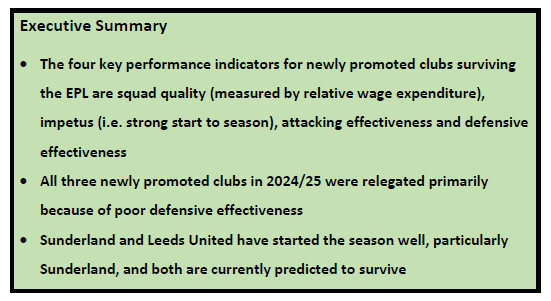
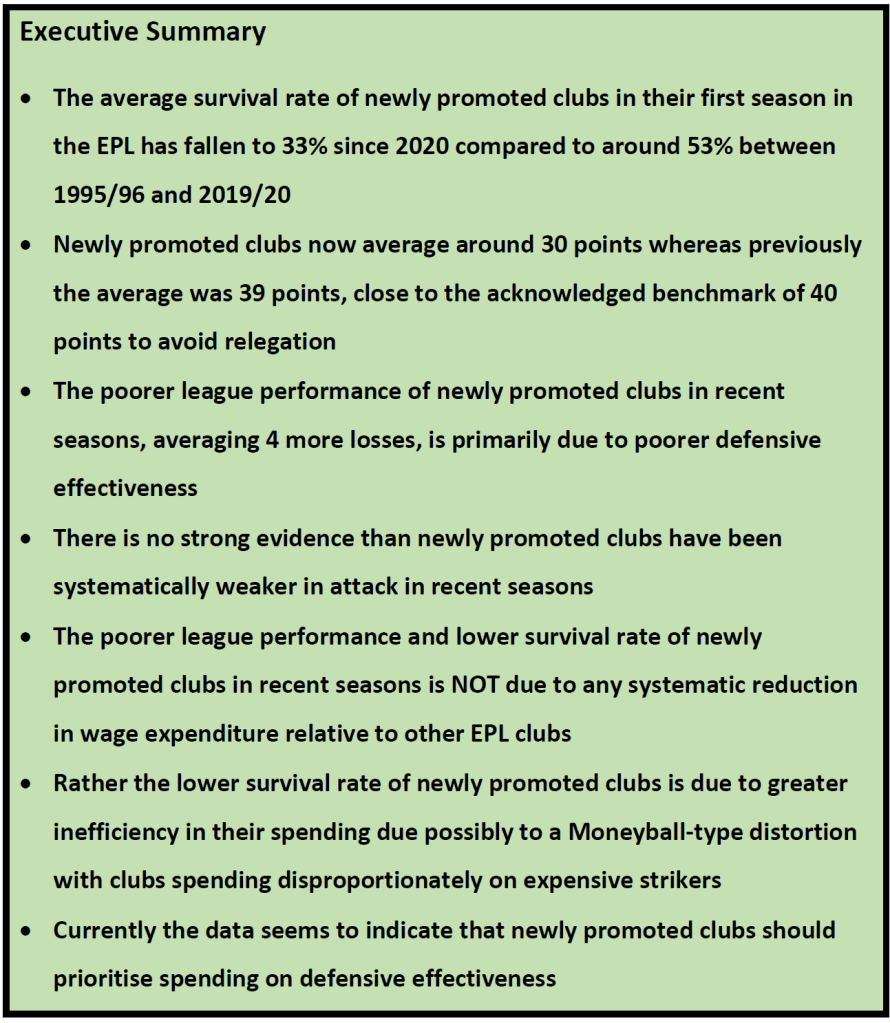
The first part of this two-part consideration of the prospects of newly promoted clubs surviving in the English Premier League (EPL) concluded that the lower survival rate in recent seasons was due to poorer defensive records rather than any systematic reduction in wage expenditure relative to other EPL clubs. It was also suggested that there might be a Moneyball-type inefficiency with newly promoted teams possibly allocating too large a proportion of their wage budget to over-valued strikers when more priority should be given to improving defensive effectiveness. In this post, the focus is on identifying four key performance indicators (KPIs) for newly promoted clubs that I will call the “survival KPIs”. These survival KPIs are then combined using a logistic regression model to determine the current survival probabilities of Burnley, Leeds United and Sunderland in the EPL this season.

The Four Survival KPIs

The four survival KPIs are based on four requirements for a newly promoted club:

  • Squad quality measured as wage expenditure relative to the EPL median
  • Impetus created by a strong start to the season measured by points per game in the first half of the season
  • Attacking effectiveness measured by goals scored per game
  • Defensive effectiveness measured by goals conceded per game

Using data on the 89 newly promoted clubs in the EPL from seasons 1995/96 – 2024/25, these clubs have been allocated to four quartiles for each survival KPI. Table 1 sets out the range of values for each quartile, with Q1 as the quartile most likely to survive through to Q4 as the quartile most likely to be relegated. Table 2 reports the relegation probabilities for each quartile for each KPI. So, for example, as regards squad quality, Table 1 shows that the top quartile (Q1) of newly promoted clubs had wage costs at least 79.5% of the EPL median that season. Table 2 shows that only 22.7% of these clubs were relegated. In contrast, the clubs in the lowest quartile (Q4) had wage costs less than 55% of the EPL median that season and 77.3% of these clubs were relegated.

Table 1: Survival KPIs, Newly Promoted Clubs in the EPL, 1995/96 – 2024/25

Table 2: Relegation Probabilities, Newly Promoted Clubs in the EPL, 1995/96 – 2024/25

The standout result is the low relegation probability for newly promoted clubs in Q1 for the Impetus KPI. Only 8% of newly promoted clubs with an average of 1.21 points per game or better in the first half of the season have been relegated. This equates to 23+ points after 19 games. Only 17 newly promoted clubs have achieved 23+ points by mid-season in the 30 seasons since 1995 and only two have done so in the last five seasons – Fulham in 2022/23 with 31 points and the Bielsa-led Leeds United with 26 points in 2020/21.

It should be noted that there is little difference in the relegation probabilities between Q2 and Q3, the mid-range values for both Squad Quality and Attacking Effectiveness, suggesting that marginal improvements in both of these KPIs have little impact for most clubs. As regards defensive effectiveness, both Q1 and Q2 have low relegation quartiles suggesting that the crucial benchmark is limiting goals conceded to under 1.61 goals per game (or 62 goals conceded over the entire season). Of the 43 newly promoted clubs that have done so since 1995, only seven have been relegated, a relegation probability of 16.3%. Reinforcing the main conclusion from the previous post that the main reason that for the poor performance of newly promoted clubs in recent seasons, only four clubs have conceded fewer than 62 goals in the last five seasons – Fulham (53 goals conceded, 2020/21), Leeds United (54 goals conceded, 2020/21); Brentford (56 goals conceded, 2021/22) and Fulham (53 goals conceded, 2022/23) – with of these four clubs, only Fulham being relegated in 2020/21 (primarily due to their poor attacking effectiveness).

Where Did The Newly Promoted Clubs Go Wrong Last Season?

Just as in the previous season 2023/24, so too last season, all three newly promoted clubs – Ipswich Town, Leicester City and Southampton – were relegated. Table 3 reports the survival KPIs for these clubs. In the case of Ipswich Town, their Squad Quality was low with relative expenditure under 50% of the EPL median. In contrast Leicester City spent close to the EPL median and Southampton were just marginally under the Q1 threshold. The Achilles Heel for all three clubs was their very poor defensive effectiveness, conceding goals at a rate of over two goals per game. Only 11 newly promoted clubs have conceded 80+ goals since 1995; all have been relegated.

Table 3: Survival KPIs, Newly Promoted Clubs in the EPL, 2024/25
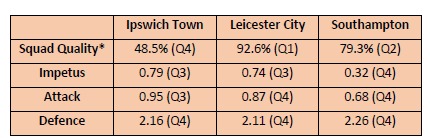
*Calculated using estimated squad salary costs sourced from Capology (www.capology.com)

What About This Season?

As I write, seven rounds of games have been completed in the EPL. Of the three newly promoted clubs, the most impressive start has been by Sunderland who are currently 9th in the EPL with 11 points which puts them in Q1 in terms of Impetus as does their Squad Quality with wage expenditure estimated at 83% of the EPL median, and their defensive effectiveness with only six goals conceded in their first seven games. Leeds United have also made a solid if somewhat less spectacular start with 8 points and ranking in Q2 for all four survival KPIs. Both Sunderland and Leeds United are better placed at this stage of the season than all three newly promoted clubs last season when Leicester City had 6 points, Ipswich Town 4 points and Southampton 1 point. Burnley have made the poorest start of the newly promoted clubs this season with only 4 points, matching Ipswich Town’s start last season but, unlike Ipswich Town, Burnley rank Q2 in both Squad Quality and Attack. Worryingly Burnley’s defensive effectiveness which was so crucial to their promotion from the Championship has been poor so far this season and, at over two goals conceded per game, on a par with Ipswich Town, Leicester City and Southampton last season.

Table 4: Survival KPIs and Survival Probabilities, Newly Promoted Clubs in the EPL, 2025/26, After Round 7
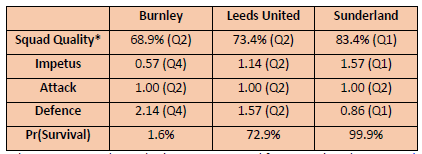
*Calculated using estimated squad salary costs sourced from Capology (www.capology.com)

Using the survival KPIs for all 86 newly promoted clubs 1995 – 2024, a logistic regression model has been estimated for the survival probabilities of newly promoted clubs in the EPL. This model combines the four survival KPIs and weights their relative importance based on their ability to jointly identify correctly those newly promoted clubs that will survival. The model has a success rate of 82.6% predicting which newly promoted clubs will survive and which will be relegated. Based on the first seven games, Sunderland have a survival probability of 99.9%, Leeds United 72.9% and Burnley 1.6%. These figures are extreme and merely highlight that Sunderland have made an exceptional start, Leeds United a good start and Burnley have struggled defensively. It is still early days and crucially the survival probabilities do not control for the quality of the opposition. Sunderland have yet to play a team in the top five whereas Leeds United and Burnley have both played three teams in the top five. I will update these survival probabilities regularly as the season progresses. They are likely to be quite volatile in the coming weeks but should become more stable and robust by late December.
How Do Newly Promoted Clubs Survive In The EPL? Part One: What Do The Numbers Say?

The English Premier League (EPL) started its 34th season last weekend with most of the pundits focusing on the top of the table and whether Arne Slot’s Liverpool can retain the title in the face of a rejuvenated challenge by Pep Guardiola’s Manchester City. Relatively little attention has been given to the chances of the newly promoted clubs – Leeds United, Burnley and Sunderland – avoiding relegation with most pundits tipping all three to follow their predecessors in the last two seasons in being immediately relegated back to the Championship. The opening weekend of the EPL season went somewhat against the doom merchants with two of the three newly promoted clubs, Sunderland and Leeds United, winning. This is the first time that two newly promoted clubs have won their first game since Brentford and Watford in 2021/22 with the only other instance of this rare feat being Bolton Wanderers and Crystal Palace in 1997/98 although it should be noted that only Brentford then went on to avoid relegation. I must of course in the interests of objectivity declare my allegiances – I have lived and worked in Leeds for over 40 years and, as a Scot growing up in the 1960s, my “English” team was always Leeds United, then packed with Scottish internationals with Billy Bremner and Eddie Gray my particular favourites. So with Leeds United returning to the EPL after two seasons in the Championship, what are the chances that Leeds United and the other two promoted clubs can defy conventional wisdom and avoid relegation? What do the numbers say?

The Dataset

The dataset used in the analysis covers 30 years of the EPL from season 1995/96 to season 2025/26. The analysis has begun in 1995/96 which was the first season that the EPL adopted its current structure of 20 clubs with three clubs relegated. Note that there were only two teams promoted from the Championship in 1995/96. League performance has been measured by Wins, Draws, Losses, Goals For, Goals Against and League Points. In order to focus on sporting performance, League Points are calculated solely on the basis of games won and drawn, and exclude any points deductions for regulatory breaches. There is no case of any club being relegated solely because of regulatory breaches. Survival Rate is defined as the percentage of newly promoted clubs that were not relegated in their first season in the EPL. Relative Wages has been calculated as the total wage expenditure of clubs as reported in their company accounts relative to the median wage expenditure of all EPL clubs that season (indexed such that 100 = median wage expenditure). This allows comparisons to be drawn across seasons despite the underlying upward trend in wage expenditure. Company accounts are not yet available for 2024/25 so there is no analysis of wage expenditure and sporting efficiency in the most recent EPL season. Total wage expenditure includes all wage expenditure not just player wages. Estimates of individual player wages and total squad costs are available but their accuracy is unknown and limited to recent seasons only. A comparison of one such set of estimated squad wage costs and the wage expenditures reported in company accounts for the period 2014 – 2024 yielded a correlation coefficient of 0.933 which suggests that the “official” wage expenditures provide a very good proxy for player wage costs. Sporting Efficiency is defined as League Points divided by Relative Wages (and multiplied by 100). Sporting Efficiency is a standardised measured of league points per unit of wage expenditure across seasons that attempts to capture the ability of clubs to transform financial expenditure into sporting performance which, when all is said and done, is the fundamental transformation in professional team sports and at the heart of the Moneyball story as to how teams can attempt to offset limited financial resources by greater sporting efficiency.

League Performance of Newly Promoted Clubs

Table 1 summarises the average league performance of newly promoted clubs over the last 30 seasons of the EPL, broken down into 5-year sub-periods in order to detect any long-term trends over time. In addition, the proposition that the average league performance has deteriorated in the last five seasons compared to the previous 25 seasons has been formally tested statistically using a t-test with instances of strong evidence (i.e. statistical significance) of this deterioration indicated by asterisks (or a question mark when is marginally weaker). The key points to emerge are:

  1. There is no clear trend in wins, draws and losses by newly promoted clubs between 1995/96 and 2019/20 but thereafter there is strong evidence that newly promoted clubs are winning and drawing fewer games and, by implication, losing more games.
  2. Newly promoted clubs averaged 4 more losses since 2020 compared to previous seasons with an average of 22.5 losses in the last five seasons as opposed to an average of 18.7 losses in previous 25 seasons.
  3. The poorer league performance in recent seasons represents a reduction in average league points from 39.0 (1995/96 – 2019/20) to 30.5 points (2020/21 – 2024/25).
  4. Given that the acknowledged benchmark to avoid relegation is 40 points, not surprisingly the survival rate of newly promoted clubs has declined in the last five seasons to only a one-in-three chance of survival (33.3%) compared to a slightly better than one-in-two chance (56.8%) in the previous 25 seasons.
  5. The data suggests strongly that the primary reason for the decline in league performance and survival rates of newly promoted clubs in the last five seasons has been weaker defensive play, not weaker attacking play. Newly promoted clubs averaged 61.1 goals against in seasons 1995/96 – 2019/20 but this rose to 73.8 goals against in the last five seasons which represents very strong evidence of a systematic change in the defensive effectiveness of newly promoted clubs. In stark contrast, the change in goals for has been negligible with a decline from 40.5 (1995/96 – 2019/20) to 38.8 (2020/21 – 2024/25) which is more likely to be accounted for by season-to-season fluctuation rather than any underlying systematic decline in attacking effectiveness.

Wage Costs and Sporting Efficiency of Newly Promoted Clubs

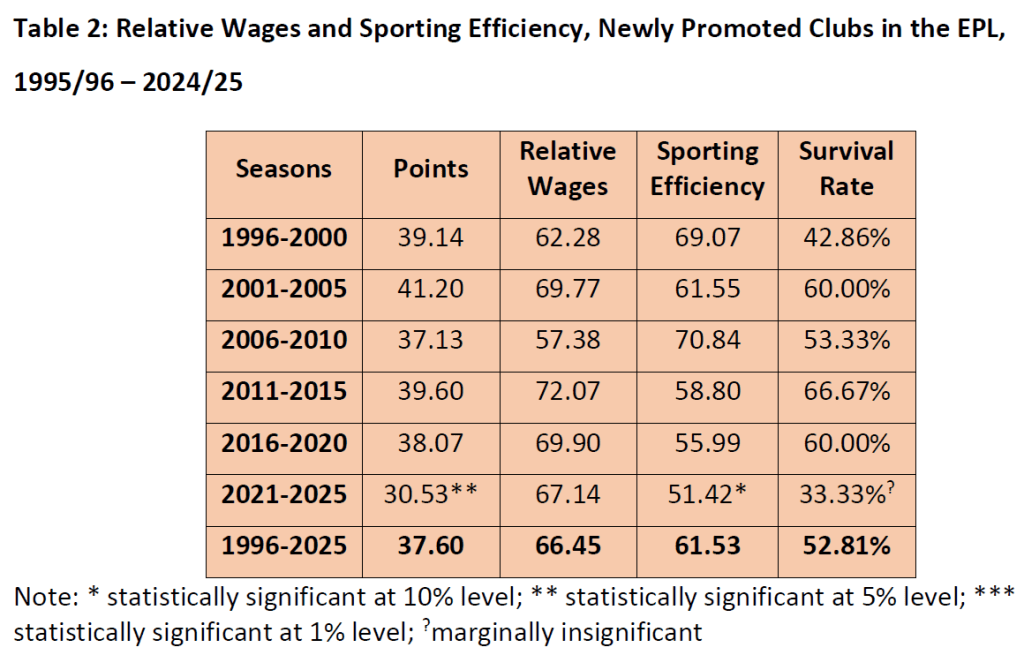
It has been frequently argued that the recent decline in the league performance and survival rates of newly promoted clubs is due to an increasing gap in financial resources between established EPL clubs and the newly promoted clubs. Table 2 addresses this issue. There is absolutely no support for newly promoted clubs being more financially disadvantaged relatively compared to their predecessors. There has been virtually no change in the relative wage expenditure of newly promoted clubs in the last five seasons which has averaged 67.1 compared to 66.3 in the previous 25 seasons. The lower survival rate in recent seasons is NOT due to newly promoted clubs spending proportionately less on playing talent.

There is a very simply equation that holds by definition:

League Performance = Relative Wages X Sporting Efficiency

Since their league performance has declined but the relative wage expenditure of newly promoted clubs has stayed more or less constant, then their sporting efficiency MUST have declined. Table 2 suggests that there may have been a downward trend in the sporting efficiency in newly promoted clubs in the last 15 seasons. In addition, there is strong evidence that there has been a systematic downward shift in the sporting efficiency in the last five seasons to 51.4 compared to the previous average of 63.2 (1995/96 – 2019/20). On its own, this is merely a statement of the obvious dressed up in mathematical and statistical formalism. Newly promoted clubs are performing worse on the pitch as a result of spending less effectively. The crucial question is why league performance and sporting efficiency have declined. The answer may lie in reflecting on the fact that, as we discovered in Table 1, the reason for the poorer league performance is primarily due to poorer defensive effectiveness not poorer attacking effectiveness. Newly promoted clubs seem to be buying the same number of goals scored with the same relative wage budget as in previous seasons but at the cost of buying less defensive effectiveness and conceding more goals. This is consistent with a Moneyball-type distortion in the EPL player market with a premium paid for strikers that may not be fully warranted by current tactical developments in the game. The numbers would support newly promoted clubs giving a higher priority to defensive effectiveness in their recruitment and retention policy and avoiding spending excessively on expensive strikers, particularly those with little experience of playing and scoring in the top leagues.

Competitive Balance Part 3: North American Major Leagues

As discussed in the two previous posts on competitive balance, there is no agreed single definition of competitive balance beyond a general statement that a competitively balanced league is characterised by all teams having a relatively equal chance of winning individual games and the league championship. The lack of agreement on a specific definition of competitive balance combined with the wide variety of league structures and the statistical problems of inferring ex ante (i.e. pre-event) success probabilities from ex post (i.e. actual) league outcomes has led to a multiplicity of competitive balance metrics. Morten Kringstad and I have argued in several published journal articles and book chapters that it is useful to categorise competitive balance metrics as either measures of win dispersion or performance persistence. Win dispersion measures the dispersion in league performance across teams in a particular season. Performance persistence measures the degree to which the league performance of individual teams is replicated across seasons – do teams tend to finish in the same league position in consecutive seasons? These are two quite different aspects of competitive balance and multiple metrics have been proposed for both. However, when it comes to discussions as to what leagues should do, if anything, to maintain or improve of competitive balance, there is a general (often implicit) presumption that all competitive balance metrics tend to move in the same direction. Morten and I have sought to discover if this is indeed the case. And, as reported in my previous post on the subject, the evidence from European football is quite mixed and, at the very least, casts doubt on the general presumption that there is a strong positive relationship between win dispersion and persistence. Indeed, we found that in the period 2008 – 2017 win dispersion and performance persistence tended to move in opposite directions in the English Premier League.

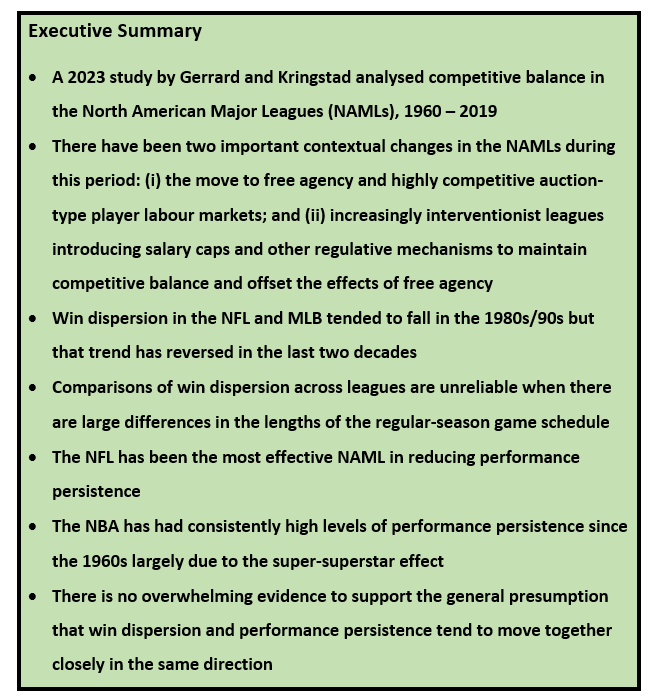
            In this post, I am going to discuss the evidence from a study on win dispersion and performance persistence in the four North American Major Leagues (NAMLs) that Morten and I published recently in Sport, Business, Management: An International Journal (vol 13 no. 5, 2023). Our dataset covered the four NAMLs – MLB (baseball), NFL (American football), NBA (basketball) and NHL (ice hockey) – seven different competitive balance metrics, and 60 seasons, 1960 – 2019 (thereby avoiding the impact of the Covid pandemic). In this post I am only focusing on the ASD* measure of win dispersion, the SRCC measure of performance persistence, and the correlation between these measures to test whether or not win dispersion and performance persistence move together in the same direction. I have reported these three measures as 10-year averages in order to identify possible trends over time. It is agreed that the ASD* metric provides better comparability of win dispersion between leagues with very different lengths of game schedules in the regular season. At one extreme the MLB has a 162-game schedule whereas for most of the period the NFL had a 16-game regular season schedule (recently increased to 17 games). The ASD* uses the actual standard deviation of team win percentages relative to the theoretical standard deviation of a perfectly dominated league with the same number of teams and games in which every team loses against the teams ranked above it so the top team wins every game, the second best team only loses against the top team, the 3rd-placed team only loses against the top two and so on. (Formally, this is called a “cascade” distribution.) The SRCC measure of performance persistence is just the Spearman rank correlation coefficient of league standings in two consecutive seasons.

            One important contextual change in most leagues since the 1960s has been the move away from a very restricted player labour market in which a player’s current team had priority in retaining a player. Instead player labour markets have become a very competitive auction-type market in which players have the right to move to another team at the end of their current contract (what is known as “free agency”). The NAML’s led the way in pro team sports in introducing some form of free agency in the 1970s/80s. European leagues lagged behind until the Bosman ruling in 1995 which effectively created free agency by abolishing transfer fees for out-of-contract players. So in some ways it should be expected that the general trend in the NAMLs has been towards greater competitive imbalance as the big-market teams have taken advantage of free agency to acquire the best players. However, there has been another general tendency with leagues becoming much more interventionist by introducing regulatory mechanisms especially salary caps which, in part, has been motivated by an attempt to offset the potential negative effect on competitive balance of free agency. Which effect has been stronger? Let’s look at the numbers.

            Table 1 below reports the 10-year averages for win dispersion for the four NAMLs. Broadly speaking, the pattern in win dispersion in the NAMLs over the last 60 years has been for win dispersion to decrease from the 1960s though to the 1990s (i.e. improved competitive balance) but for win dispersion to increase since the 1990s (i.e. reduced competitive balance). Both the MLB and NFL follow this pattern, suggesting that the league intervention effect may have initially dominated the free agency effect but in recent years the resource-richer teams may have adapted to the more regulated environment and found other ways to exert their financial advantage (while remaining compliant with league regulations) such as higher expenditures on technology and data analytics. I used to argue that the Oakland A’s and the Moneyball phenomenon is an example of data analytics being used as a “David” strategy for resource-poorer teams to compete more effectively. And it is true that in the early days of sports analytics it was often the resource-poorer teams that led the way in operationalising data analytics as a source of competitive advantage. But these days most teams recognise the potential gains from analytics and some very resource-rich teams are investing heavily in data analytics.

            The trends in win dispersion are much less clear in both the NBA and NHL. There has been some underlying trend from the 1960s onwards for competitive balance to worsen in the NBA as win dispersion has increased. In contrast, the NHL has tended to experience an improvement in competitive balance with lower win dispersion since the turn of the century.

            When win dispersion across the four NAMLs are compared, there is a rather surprising result that the NFL has the highest degree of win dispersion over the whole period (i.e. low competitive balance) whereas the MLB has the lowest win dispersion (i.e. high competitive balance) with the NBA and NHL in the mid-range. I say surprising since conventional wisdom is that NFL has been one of the most proactive leagues in trying to maintain a high level of competitive balance whereas traditionally the MLB has been much less interventionist. The problem in making comparisons across leagues especially in different sports is the “apples-and-oranges” problem – trying to compare like with like. As highlighted earlier, there are massive differences between the NAMLs in the length of regular-season game schedules. I am more inclined to the view that the difference in win dispersion between the NAMLs is more a reflection of the difficulties in constructing a metric that properly controls for the length of game schedules, that is, it is more a measurement problem than a “true” reflection of differences in competitive balance.

            The argument that win dispersion metrics can pick up trends within leagues but is less reliable for comparisons across leagues is reinforced by the results for performance persistence reported below in Table 2. Performance persistence measures the degree to which the final standings of teams are replicated in consecutive seasons. The length of game schedule has a much more indirect effect on performance persistence so that comparisons across leagues should be more reliable. And, indeed, we find that from the 1980s onwards the NFL has had the lowest degree of performance persistence which fits with the conventional view that the NFL has been the most proactive league in maintaining a high degree of competitive balance. Winning NFL teams face a number of “penalties” in the next season – tougher game schedules, lower-ranked draft picks and the constraints imposed by the salary cap in retaining free agents who have increased in value by virtue of their on-the-field success. It is more and more difficult for NFL teams to become “dynasty” teams which makes the Belichick-Brady era at the New England Patriots and, most recently, the success of the Kansas City Chiefs so remarkable.

            As well as the NFL, the other NAML that has managed to reduce the degree of performance persistence is the NHL which had the highest degree of performance persistence in the 1960s and 1970s but now ranks second best behind the NFL. The MLB experienced reduced performance persistence in the 1980s and 1990s ( and had, on average, lower performance persistence than the NFL in the 1990s) but that downward trend has been reversed in the last two decades. The one major league that has had no discernible trend in performance persistence over the last 60 years and has the highest degree of performance persistence is the NBA despite instituting a salary cap albeit a rather “soft” cap with a number of exemptions. The high performance persistence of basketball teams is inherent in the very structure of the game. With only five players on court for a team at any point in time, basketball is much more susceptible to the “Michael Jordan” (i.e. “super-superstar”) effect and the soft salary cap makes it easier to retain these super-superstars.

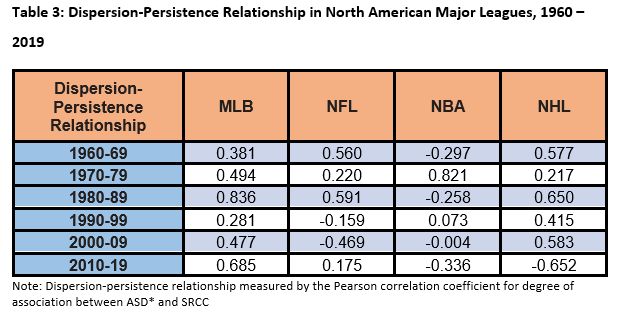
            The final set of results reported in Table 3 show how the relationship between win dispersion and performance persistence has varied over time and between leagues. One of the main motivations for this research is to determine whether or not the general presumption of a strong positive dispersion-persistence relationship is empirically valid. The evidence is mixed. There are only eight instances of a strong positive dispersion-persistence relationship (r > 0.5) out of a possible 24 which is hardly overwhelming evidence in favour of the general presumption. If medium-sized effects are included (0.3 < r < 0.5) then only half of the reported results provide support for the general presumption of a positive relationship with three strong/medium negative results and nine showing only small/negligible effects. There is one instance of a strong negative dispersion-persistence relationship in the NHL in 2010-19 indicating that reductions in performance persistence were associated with increases in win dispersion.

Competitive balance in the NAMLs has been much researched over the last 30 years. The results of our study are broadly in line with previous results but highlight that any conclusions are likely to be time-dependent and metric-dependent. The most definitive results are those on performance persistence which show a general tendency in both the NFL and NHL for improved competitive balance despite the advent of free agency. There is also clear evidence of  continuing high levels of performance persistence in the NBA, likely to be due to the super-superstar effect inherent in the game structure of basketball. As for the general presumption that win dispersion and performance persistence tend to move together in the same direction, there is no overwhelming support that they do so in most cases. The practical implication is that leagues need to be clearer on which aspect of competitive balance is most important in driving uncertainty of outcome and spectator/viewer interest. Leagues must also recognise that the structures of their sports may limit the extent to which competitive balance can be regulated. Basketball is always likely to more susceptible to super-superstar effects that can lead to high levels of performance persistence. And leagues with short game schedules may always tend to have higher levels of win dispersion since there is more limited opportunity for winning or losing streaks to even themselves out – what statisticians call the “regression-to-the-mean” effect.

Other Related Posts

Competitive Balance Part 1: What Are The Issues?

Competitive Balance Part 2: European Football

Note: The results reported in this post are published in B. Gerrard and M. Kringstad, ‘Dispersion and persistence in the competitive balance of North American Major Leagues 1960 – 2019‘, Sport, Business, Management: An International Journal, vol. 13 no. 5 (2023), pp. 640-662.

Competitive Balance Part 2: European Football

As discussed in the previous post, ‘Competitive Balance Part 1: What are the Issues?’ (24th Jan 2024), competitive balance remains an elusive concept in many ways. There is considerable disagreement over the definition and measurement of competitive balance which has generated multiple metrics. In addition, the variety of real-world nuances in the structure of sporting tournaments across different sports and different countries has exacerbated the problem as refinements to existing metrics are proposed to improve comparability across sports and countries.

Morten Kringstad and I have attempted to bring some order to the chaos by arguing that competitive balance metrics can be categorised by their timeframe and scope. In particular, as regards timeframe, competitive balance metrics either focus on the distribution of sporting outcomes of participants within a single season (i.e. win dispersion) or the degree to which to which participants replicate their level of sporting performance across seasons (i.e. performance persistence). Competitive balance metrics also differ in respect to their scope, either including all of the participants (i.e. whole league) or a subset of the strongest/weakest performers (i.e. tail outcomes).

The practical problem created by the multiplicity of competitive balance metrics is identifying which metrics should be used by league authorities in determining whether or not intervention is required to improve competitive balance. There is no general definitive empirical evidence on which aspects of competitive balance impact on gate attendances and TV viewing. There seems to be an implicit assumption that the competitive balance metrics tend to move together in the same direction, so that interventions such as centralised revenue distribution and salary caps would be expected to improve both win dispersion and performance persistence. Is this assumption valid? This is the question that Morten and I investigated in an exploratory study published in 2022 on competitive balance in European football.

Competitive Balance in European Football Leagues (EFLs)

The dataset compiled by Morten and I covers the 18 best attended, top tier domestic leagues in European football. We grouped the leagues into three groups – the Big Five (England, France, Germany, Italy and Spain), medium-sized leagues (including the Netherlands and Scotland) and the smaller–sized leagues (including Denmark and Norway). We used final league positions for ten seasons from 2008 to 2017. In the published study we reported seven alternative competitive balance metrics but found that the four win dispersion metrics were highly correlated with each other but much less so with the performance persistence metric which supports our contention of differentiating between these two types of metric. Some of the key results are reported in Table 1 below.

Table 1: Competitive Balance in European Football Leagues, 2008 – 2017

The English Premier League (EPL) stands out as the least competitively balanced of the Big Five leagues with the highest 10-year average for both win dispersion and performance dispersion. The Spanish La Liga has similar levels of competitive dominance as the EPL. In contrast, the German Bundesliga and the French Ligue 1 are the most competitively balanced. The Bundesliga has the lowest 10-year average for performance persistence across all teams. But the Bundesliga has the highest championship concentration in that period due to the dominance of Bayern Munich who won the league seven out of ten of those seasons. It is also noticeable that smaller EFLs tend to be more competitively balanced in win dispersion, performance persistence and championship concentration compared to the Big Five and the medium-sized leagues.

As regards the dispersion-performance relationship, across all 18 leagues there is a general tendency for a small positive relationship between win dispersion and performance persistence. But the dispersion-persistence relationship is highly variable across leagues especially in the Big Five. In the Spanish La Liga, which is one of the least competitively balanced leagues in our sample due to the dominance of the two global “super” teams – Real Madrid and Barcelona, there is a strong positive relationship between win dispersion and performance persistence. On the other hand, the German Bundesliga which, as highlighted above, is one of the most competitively balanced leagues despite the dominance of Bayern Munich, has a negligible dispersion-persistence relationship. The most surprising result is that for the EPL which has a strong negative relationship between win dispersion and performance persistence. The Juliper Pro League in Belgium and the Dutch Eredivisie also display a similar strong negative dispersion-persistence relationship during these ten seasons. As sporting performance becomes more dispersed across teams within a season in these three leagues, there is a tendency for sporting performance of teams to become less persistent across seasons. Perhaps this strong negative dispersion-persistence relationship is the part of the explanation of the paradox (at least in the eyes of sports economists) that the EPL is one of the least competitively balanced football leagues but remains the most commercially successful football league in the world.

What could be causing the win dispersion and performance persistence to be strongly negatively related in the EPL in defiance of the usual assumption that all competitive balance metrics tend to move together in the same direction? In our published study Morten and I develop a simple theoretical model that shows a negative dispersion-persistence relationship is more likely when there are strong persistence effects amongst the smaller teams. We suggest that the continuing growth of the value of the EPL’s media rights is putting the smaller teams in a particularly advantageous position vis-à-vis newly promoted teams and increasing the likelihood of incumbent teams avoiding relegation. And, on the other side of the coin, there is a greater likelihood of newly promoted teams becoming yo-yo teams, bouncing between the EPL and the Football League Championship.

Other Related Posts

Competitive Balance Part 1: What Are The Issues?

Financial Determinism and the Shooting-Star Phenomenon in the English Premier League

Note: The results reported in this post are published in B. Gerrard and M. Kringstad, ‘The multi-dimensionality of competitive balance: evidence from European football’, Sport, Business, Management: An International Journal, vol. 12 no. 4 (2022), pp. 382-402.

Competitive Balance Part 1: What Are The Issues?

The importance of competitive balance and uncertainty of outcome for professional sports leagues is axiomatic not only in academia but also within the sports industry and the media in general. But what is competitive balance? There are a multitude of definitions and metrics. Competitive balance clearly means different things to different people. Its importance is also problematic. The English Premier League (EPL) is often cited as an example of a competitively dominated league but its gate attendances and TV ratings continue to grow, as does the value of its domestic and international media rights.

            I have long held an interest in competitive balance both as a sports economist and as a sports fan. I have presented at various academic and industry conferences and workshops on the subject over the years as well as publishing journal articles and book chapters. Much of my research on competitive balance has been in collaboration with Morten Kringstad, a Norwegian sports economist who completed a doctoral dissertation on competitive balance at Leeds University Business School

            In this post I want to discuss competitive balance in terms of four issues – definition, significance, measurement and implications. In two subsequent posts I will present empirical evidence on competitive balance in both European football and the North American major leagues that Morten and I have published in recent journal articles.

Definition

What is competitive balance? In the most general sense, competitive balance is the distribution across teams of the probability of sporting success in a league. (Although my focus is primarily with competitive balance in professional teams sports in which teams compete in a league-structured tournament, competitive balance can apply to both individual and team sports and to both league and elimination tournaments.) Perfect competitive balance implies that all teams in a league have an equal probability of sporting success. This, in turn, would require an equal distribution of playing and coaching talent across all teams. Competitive dominance (i.e. competitive imbalance) implies that a small number of teams in a league have high probabilities of sporting success with all the other teams having close to zero probability of sporting success.

Significance

Why is competitive balance important? Sports economists have long argued that uncertainty of outcome is a necessary requirement for the financial viability of professional sports leagues. Sporting contests are unscripted drama in which there is no need for the audience to suspend their belief to create uncertainty over the outcome. But teams vary in their economic power as a matter of history and geography. Teams located in large metropolitan areas have a larger potential local fanbase. Fans from outside the team’s local catchment area are often attracted by a team’s current success. The bigger a team’s fanbase, the bigger its potential economic power to monetise its sporting operations through gate receipts, corporate hospitality, merchandising, sponsorship and media rights. There is also the possibility of non-indigenous economic power through the acquisition of the team by a wealthy ownership. The constant threat is a league may become competitively dominated by a small group of very economically powerful teams, possibly just one “super” team, so that there is no longer any real uncertainty of outcome leading to a loss of general engagement with the league and the consequent decline in revenues.

Measurement

How is competitive balance measured? Competitive balance is an ex ante concept in the sense that it refers to expected sporting outcomes. Competitive balance is most appropriately measured by betting odds or the actual distribution of playing and coaching resources (or the financial resources available to teams to spend on their sporting operations). Within the academic literature, the empirical focus has typically been on ex post competitive outcomes i.e. the distribution of actual sporing performance across teams.

            As I indicated in my introductory remarks, one of the main problems in the research on competitive balance is the large number of alternative metrics. One of main themes of my research, particularly my collaboration with Morten Kringstad, has been to construct a classification system to bring some order to the chaos of the multiple competitive balance metrics. Essentially competitive balance metrics can be classified in terms of two dimensions – timeframe and scope. As regards the timeframe, competitive balance metrics can be grouped into those focused on competitive balance in a single season and those that focus on multiple seasons. Single-season metrics are termed “win dispersion” and seek to measure the distribution of sporting outcomes across teams in one league season. The original formulation of this metric is the relative standard deviation (RSD) which measures the actual standard deviation of team win percentages as a ratio of the standard deviation for an ideal league of the same size in which every team has a 50-50 chance of winning every game (statistically this ideal league is modelled as a binomial distribution with match outcomes treated as equivalent to a fair coin toss). Multiple-season measures are termed “performance persistence” and measure the extent to which teams replicate the same level of performance across seasons. One widely used measure of performance persistence is the rank correlation of league positions of teams in successive seasons.

Win dispersion and performance persistence represent different aspects of competitive balance – is a league characterised in each season by teams being closely grouped together with similar win-loss records (i.e. low win dispersion)? do the same teams tend to finish towards the top/middle/bottom of the league every season (i.e. high performance persistence)? Win dispersion and performance persistence are not the same thing and it is not clear which is more important in driving gate attendances and TV ratings. And win dispersion and performance persistence need not necessarily move together over time. (The dispersion-persistence relationship is a particular focus of the empirical evidence to be presented in subsequent posts on competitive balance.)

            The scope dimension refers to whether the competitive balance metrics are calculated for the whole league using the sporting outcomes of all teams (whole-league metrics) or are focused on just the top and/or bottom of the leagues (tail-outcome metrics). One widely reported tail-outcome metric is the concentration of league championship titles. Other tail-outcome metrics include those measuring the concentration of play-off qualification and, in merit-hierarchy leagues, the frequency with which newly-promoted teams are relegated.

            It is easy to see why there is such a multiplicity of competitive balance metrics. Not only are there differences in timeframe and scope, there are also differences in the how dispersion, persistence and concentration can be defined formally. For example, dispersion has been defined using standard deviation, degree of inequality, entropy  and distribution shares. Also many measures are calculated relative to some concept of perfect/maximum competitive balance and/or perfect competitive dominance which, in turn, can be defined in various ways. In addition, real-world leagues differ in their size and structure, requiring adjustments to standard metrics to ensure comparability across leagues.

Implications

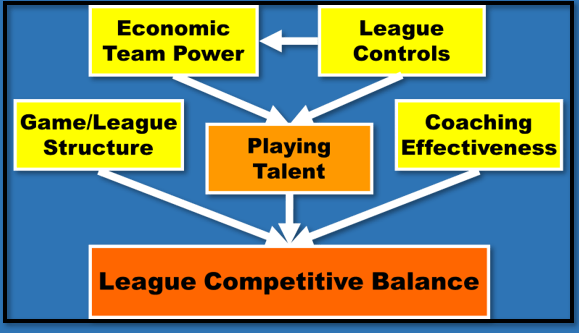
What are the implications of competitive balance for leagues? As previously suggested, it is widely believed that professional sports leagues can only remain economically viable if they maintain a degree of competitive balance. However, what exactly this means in practical terms is far from clear. There is a multiplicity of competitive balance metrics and no definitive empirical evidence on the extent to which win dispersion and/or performance persistence influences gate attendances and TV ratings. But what is understood is that ultimately the principal driver of competitive balance is the distribution of playing talent between teams.

Figure 1: The Drivers of Competitive Balance

Leagues have used a variety of regulatory mechanisms to try to equalise the distribution of playing talent between teams. These regulatory mechanisms can be broadly categorised as direct or indirect controls. Direct controls operate directly on the player labour market and seek to prevent the economically more powerful teams from cornering the market for the best players by outbidding smaller teams in the salaries offered. Direct controls limit either how much teams can spend on playing talent (e.g. salary caps) or restrict the extent to which playing talent is allocated between teams by the market mechanism (e.g. draft systems). Indirect controls try to equalise the economic power of teams by some form of revenue redistribution. Traditionally this was done by sharing gate receipts but in recent years leagues have used the allocation between teams of the revenues from the collective selling of league media and sponsorship rights.

Other Related Posts

Financial Determinism and the Shooting-Star Phenomenon in the English Premier League

The Drivers of Sporting Efficiency

Executive Summary

  • The basic production process in pro team sports is converting financial expenditure on playing talent into sporting performance
  • Any process can be summarised as Resource x Efficiency = Performance
  • Sporting efficiency is measured by the wage cost per win (i.e. the win-cost ratio)
  • Teams pursuing a “David” strategy seek high sporting performance on a limited financial budget by achieving high levels of sporting efficiency
  • Sporting efficiency can be decomposed into two components: (i) transactional efficiency i.e. maximising the quality of playing talent acquired per unit wage cost; and (ii) transformational efficiency i.e. maximising the sporting performance of a given playing squad
  • The original Moneyball story was about how the Oakland A’s used data analytics to achieve exceptional levels of transactional efficiency in recruitment
  • The “new” Moneyball story is how teams are using data analytics to maximise transformational efficiency 

All professional sports teams consist of two operations: (i) the sporting operation which produces the team’s core product, namely, on-the-field sporting performance; and (ii) the business operation tasked with monetarising the sporting performance through a variety of revenue streams, principally matchday receipts, media, sponsorship and merchandising. The basic production process in professional team sports is the conversion of financial expenditure on playing talent into sporting performance. Simply put, pro sports teams are in the business of turning wages into wins.

            Any process can be summarised  as

RESOURCE x EFFICIENCY = PERFORMANCE

In the case of pro sports teams, the resource (i.e. input) is the financial budget available to spend on playing talent. For the moment to keep things simple, let us assume initially that the resource represents wage expenditure on players. Performance is sporting performance which , again for simplicity, we will assume initially comprises competing in a league with performance measured by wins or league points. The efficiency of any process represents the rate at which input can be converted into output. Sporting efficiency is measured by the rate at which wage expenditure can be converted into wins (or league points). It is conventional to express sporting efficiency as the wage cost per win, often referred to as the win-cost ratio. In leagues with tied games and/or bonus points, sporting efficiency is best measured as the wage cost per point.

            The Resource-Efficiency relationship captures the strategic differences between teams. Typically leagues consist of a mix of big-market teams and smaller teams. The big-market teams are usually located in big metropolitan areas and have a history of sporting success. Their fanbases are large and loyal so that these teams are economically powerful, financial Goliaths in sporting terms who are able to afford large player wage budgets which gives them a strategic advantage over the smaller teams. The economically smaller teams with more limited financial budgets can only remain competitive in a financially sustainable way by developing a “David” strategy to achieve high levels of sporting efficiency. Leagues concerned about the competitive dominance of the big-market teams often attempt to restrict the resource differential between teams through measures such as (i) salary caps and other financial restrictions on player wage expenditures; (ii) revenue redistribution through centralised media and sponsorship deals; and (iii) direct controls on the player labour market including centralised player drafts.

            Sporting efficiency can be decomposed into two components: transactional efficiency and transformational efficiency. Transactional efficiency refers to the efficiency with which teams spend their player wage budget to acquire playing talent. Teams with high transactional efficiency maximise the quality of playing talent acquired per unit wage cost. Transformational efficiency refers to the efficiency with which a playing squad is trained and utilised to win sporting contests. Transformational efficiency is all about maximising the sporting performance achieved by a given playing squad. Transactional efficiency is the responsibility of the recruitment department whereas transformational efficiency is the responsibility of the coaching staff and the other sporting support staff. Transactional and transformational efficiency are interdependent. Effective recruitment is not solely about identifying high-quality players undervalued in the market. These players must be high quality in team-specific terms by which I mean, players with the qualities to be able to adapt and perform within the specific training regime and playing style of the team.

Figure 1: Decomposing Sporting Efficiency

In recent years there has been considerable focus on the use of data analytics as a  key element in the David strategy of teams seeking to maximise sport efficiency. The original Moneyball story was about how the Oakland A’s used data analytics to achieve exceptional levels of transactional efficiency in recruitment. At the core of the A’s analytics-driven recruitment strategy was their innovative use of On-Base Percentage (OBP) as a key metric to identify undervalued batters. In a study that I published in 2007, I estimated that the A’s were 59.3% more efficient than the MLB average over the period 1998-2007 which represents Billy Beane’s first nine seasons as GM. This calculation was based on the win-cost ratio after allowing for wage inflation.

            What I call the “New Moneyball” is the application of data analytics to enhance the transformational efficiency of teams. In this respect, I find it useful to think of playing talent holistically using what I call the 4 A’s – Ability (i.e. technical skills), Athleticism (i.e. physical skills), Attitude (i.e. mental skills) and Awareness (i.e. decision skills). Data analytics is contributing to all of these aspects of playing talent, augmenting the work of coaches, sport scientists, strength and conditioning trainers and sport psychologists.

            One final issue – the simplifying assumptions in the measurement of both the cost of playing talent and sporting performance need to be reviewed. As regards the cost of playing talent, there is the complication of how to treat transfer fees particularly given their importance in (association) football. One alternative is that adopted by Tomkins et al, Pay As You Play (GPRF Publishing, 2010) who provided a detailed analysis of what they called “the price of success” in the English Premier League (EPL), 1992 – 2010, using their Transfer Price Index. Their efficiency measure was the transfer cost per league point using the inflation-adjusted transfer value of the playing squad. Another approach is what I would call “the full-cost method” in which acquisition costs are included as well as wage costs. The simplest version of this method is to combine the annual amortisation charge on transfer fees paid with annual wages and salaries. My own preference is to use the wages-only method in analysing what I would call “operating-cost sporting efficiency” and to separately analyse the ”capital-cost sporting efficiency” of transfer fees paid and received.

            As regards the measurement of sporting performance, the principal problem again arises primarily in football when the top teams compete in two elite tournaments – their own domestic league and an international tournament. For example, top English teams compete in both the EPL and the UEFA Champions League. Their sporting efficiency should be assessed in terms of their performance in both tournaments. But trying to a create a composite measure of sporting performance in multiple tournaments is difficult and aways open to the charge of arbitrariness. So, just as in the case of the measurement of player costs, I advocate separability i.e. analyse the efficiency of sporting performance in different tournaments separately. Ultimately it comes down to making meaningful comparisons using metrics that are transparent and measured consistently to ensure that we are comparing like with like as much as possible. So, for example, it is much more informative to compare the wage cost per point of the EPL teams competing in the UEFA Champions League with each other and then separately compare the wage cost per point of the other EPL teams.

Other Related Posts

The IPL Player Auction

Executive Summary

  • There were three key features of the IPL auction values of players in 2023:
  1. A premium was paid for top Indian talent
  2. High values were attached to top but more risky overseas talent
  3. It cost more to buy runs scored than it did to limit runs conceded
  • Mumbai Indians were the top batting side in 2023 but ranked poorly on bowling hence the expectation that they will focus on strengthening their bowling resources in the 2024 auction
  • This intention has clearly been signalled by the release of a large number of their bowlers and the high-profile trade for the return of Hardik Pandya
  • In any auction there is an ever-present danger of the Winner’s Curse – winning the auction by bidding an inflated market value well in excess of the productive value 

During my recent visit to the Jio Institute in Mumbai, I undertook some research on the player auction in the Indian Premier League (IPL). I also used the IPL as the context to investigate the topics of player ratings and player valuation with my graduate sport management class. The discussion with my students, several of whom had a very good knowledge of the IPL and individual teams and players, was motivated by Billy Beane’s involvement in the IPL as an advisor to the Rajasthan Royals. In a recent conversation with Billy, he commented that cricket is undergoing its own sabermetrics revolution. So the question I set the students – are there any apparent Moneyball-type inefficiencies in the valuation of players in the IPL player auctions, with a specific focus on last year’s auction? And looking ahead, could we predict the strategies that individual teams might adopt in the 2024 auction to be held in Dubai on 19th December?

Looking at the 2023 IPL player auction, there appear to be three key features of the player values:

  1. There is a premium paid for top domestic talent when these players become available
  2. High values are attached to top overseas talent but they are higher risk
  3. It costs more to buy runs scored than it does to limit runs conceded

It is no surprise that top Indian players command the highest values – they are experienced and effective in the playing conditions, are big box-office draws, and have high scarcity value. These players are the first on their current team’s retained list and both difficult and expensive to prise them away to another team with a sufficiently lucrative deal for all parties.

As a consequence, teams are forced to focus on the overseas market to find an alternative source for top talent. But this can be a high-risk strategy. Often these players have little or no previous experience in playing in the IPL or even playing in India. Their availability for the whole tournament can be problematic. For example, the IPL overlaps the early part of the English domestic season and top English players are likely to have commitments to the national teams in both test and limited-overs matches. And there is the ever-present risk of injury as the playing schedule extends throughout the whole year. Two of the top valued players in last year’s IPL player auction were Ben Stokes and Harry Brook. Stokes was limited to bowling only one over and had two short innings with the bat before injury ended his IPL season; his obvious priority as captain of the England test team and the inspiration behind the Bazball approach was to get fit for the Ashes series. He has just been released by Chennai Super Kings and has undergone knee surgery in the last few days. Stokes will not be available for the IPL in 2024. Understandably, Harry Brook as an emerging star, commanded one of the highest auction values but his performances in his first season in the IPL were disappointing by his high standards. On my rating system, he ranked only 44th out of the 50 batsmen with 11+ innings but was the 5th highest valued player in the auction. Sunrisers Hyderabad have waived their right to retain his services for the IPL in 2024.

In a number of pro team sports, there is tendency for teams to put a higher value on offensive players who score compared to defensive players who prevent scores being conceded. This is a market inefficiency since a score for has the same weighting as a score against in determining the match outcome. The inefficiency is perhaps more explicable in the invasion-territorial team sports such as the various codes of football since it is more difficult in these sports to separate out the impact of individual player contributions. And, after all, scoring is an observable event whereas defence is about preventing scoring events occurring so there is added uncertainty as to whether or not a score would have been conceded had it not been for a particular defensive action by a player. But this inefficiency is much less explicable in striking-and-fielding team sports such as baseball and cricket where the responsibility for scores conceded can be much more clearly be allocated to individual pitchers/bowlers and fielders. So perhaps a Moneyball-type strategy could be adopted by IPL teams who are weaker in their bowling.

Given that I was based in Mumbai and visiting the Jio Institute which has been established by Reliance Industries who also own the Mumbai Indians franchise, the obvious team to analyse were the Mumbai Indians. I hasten to add that I am not privy to any “inside information” and all of my analysis is based on publicly available data. Table 1 below summarises the batting and bowling performances of the 10 IPL team in 2023.

Table 1: Team Summary Performance, Batting and Bowling, IPL 2023

Note: Runs scored and runs conceded are calculated per ball for all matches (i.e. regular season and end-of-season playoffs). The overall batting and bowling rankings include a number of metrics other than just the scoring and conceding rates.

As can be seen in Table 1, the Mumbai Indians topped the charts in batting but performed relatively poorly in bowling. This suggests that their focus in the coming auction will be on strengthening their bowling. Their intent has clearly been signalled by the release of a large proportion of their bowlers and the high-profile trade for the return of Hardik Pandya.

One final thought as regards the forthcoming IPL player auction. In any auction there is an ever-present danger of the Winner’s Curse – winning the auction by bidding an inflated market value well in excess of the productive value. “Winning the battle, losing the war.” Any bidder in any auction is well advised to have a clear idea of the expected productive value of the future performance of the asset for which they are bidding. In the case of players, it is vital to have a well-grounded estimate of the future value of both the player’s expected incremental contribution on-the-field as well as their image value off-the-field. This should set the upper bound for a team’s bid for their services. As in any acquisition, you are buying the future not the past. Outbid the other teams and you secure the employment contract for the player giving you the rights to the uncertain future performance of the player. Past performance is a guide to possible future performance but you must always factor in the uncertainty inevitably attached to expected future performance.

Football, Finance and Fans in the European Big Five

Executive Summary

  •  Divergent revenue growth paths in the Big Five European football leagues since 1996 has more than doubled the inequality in the financial strength of these leagues.
  • The financial dominance of the EPL is based on growing gate attendances, increasing value of media rights and high marketing efficiency.
  • The financial dominance of the EPL puts it at a massive advantage in attracting the best sporting talent.
  • The pandemic highlighted the precarious financial position of the French and Italian leagues due to high wage-revenue ratios and consequent operating losses
  • The financial regulation of the Bundesliga clubs put them in a much stronger position to cope with loss of revenues during the pandemic.

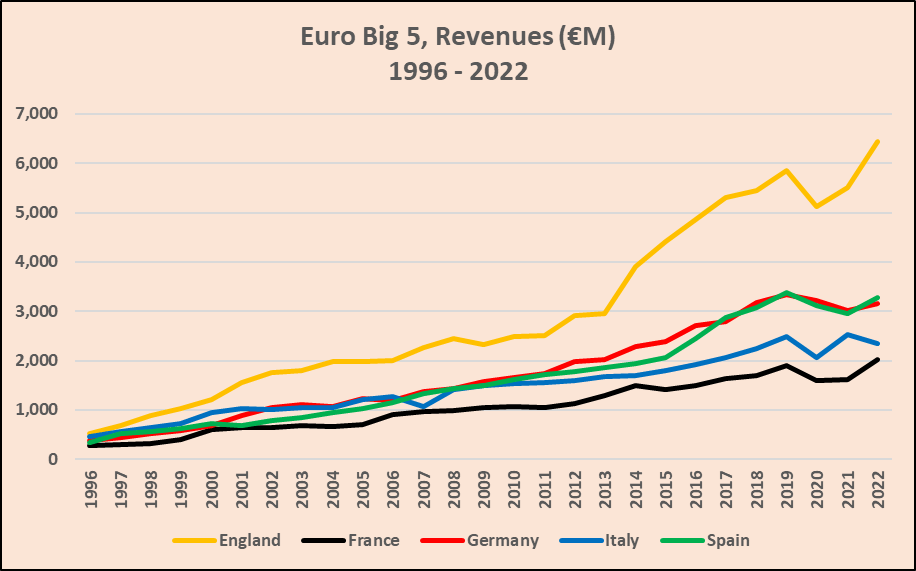
The top tiers of the domestic football leagues in England, France, Germany, Italy and Spain constitute the so-called “Big Five” of European football in financial terms as measured by the total revenues of their member clubs. Figure 1 shows the growth in revenues in the Big Five since 1996. The most striking feature of this timeplot is the divergent growth paths of the Big Five. From a starting point of relative parity in 1996 the divergent growth paths of the Big Five call into question whether it is even appropriate to still talk in terms of the Big Five. Using the coefficient of variation (CoV) as a measure of relative dispersion (effectively CoV is just a standardised standard deviation with the scale effect removed), the degree of dispersion between the revenues of the Big Five has more than doubled from 0.244 in 1996 to 0.509 in 2022. The English Premier League (EPL) is quite literally in a league of its own in financial terms with total revenues of €6.4bn in 2022. The rest of the Big Five lag a long way behind with the Spanish La Liga and German Bundesliga grossing revenues of €3.3bn and €3.1bn, respectively in 2022 and the Italian Serie A and French Ligue 1 lagging another €1bn or so behind with revenues of €2.4bn and €2.0bn, respectively. And with the expected uplift in the EPL’s next media rights deal and the continued growth in gate attendances, the gap between the EPL and the rest of the Big Five looks set to increase further.

Figure 1: Revenues (m), European Big Five, 1996 – 2022

Another key feature of Figure 1 is the impact of the Covid pandemic on league revenues. The biggest losers in 2020 were the EPL clubs with the postponement of the last part of the 2019/20 leading to an overall loss of revenue of around €0.7bn. But although the whole of the 2020/21 season was played behind closed doors wiping out matchday revenues, media revenues increased with all games shown live. By 2022 with the return of spectators to football grounds and continued growth in media revenues, the EPL was back on its pre-pandemic trend with revenues over 10% higher than in 2019 prior to the pandemic. In contrast, of the other Big Five, only the French Ligue 1 had increased revenues in 2022 above the pre-pandemic level.

In assessing the revenue performance of football leagues/clubs, apart from revenue growth rates, there are two very useful revenue KPIs (Key Performance Indicators):

Media% = media revenues as a % of total revenues; and

Local Spend = non-media revenues per capita (using average league gate attendances as the size measure to standardise club/league revenues)

Media% shows the dependency of the league and its clubs on the value of their media rights. Local Spend is a measure of the marketing efficiency of clubs in generating matchday and commercial revenues relative to the size of their active fanbase as measured by average league gate attendance. As can be seen in Table 1 which reports these two revenue KPIs for 2019, 2021 and 2022, all the Big Five became much more dependent on media revenues during the Covid years as seen in the increased Media% in 2021. As would be expected Local Spend fell sharply in the Covid years with the loss of matchday revenues. What is more concerning in the longer term for the rest of the Big Five is that the financial strength of the EPL is based not only on the much higher value of their media rights but also the stronger capability of EPL clubs to generate matchday revenues and commercial revenues. Prior to the pandemic only the Spanish La Liga got close to the EPL in terms of Local Spend but by 2022 the EPL had a substantial lead over all of the other Big Five in Local Spend. Given as noted earlier, the underlying upward trends in gate attendances and the value of media rights in the EPL, when you also allow for the marketing efficiency advantage as measured by Local Spend, the financial dominance of the EPL seems likely to grow unabated in the coming years.

Table 1: Revenue KPIs, European Big Five, Selected Years

LeagueMedia%Local Spend (€)
201920212022201920212022
England59.12%68.66%54.14%3,1312,1893,732
France47.37%51.80%35.98%2,1921,7272,879
Germany44.33%55.21%43.82%2,1431,6462,164
Italy58.52%69.92%56.94%2,0491,3831,842
Spain54.25%67.74%58.53%2,8711,6472,354

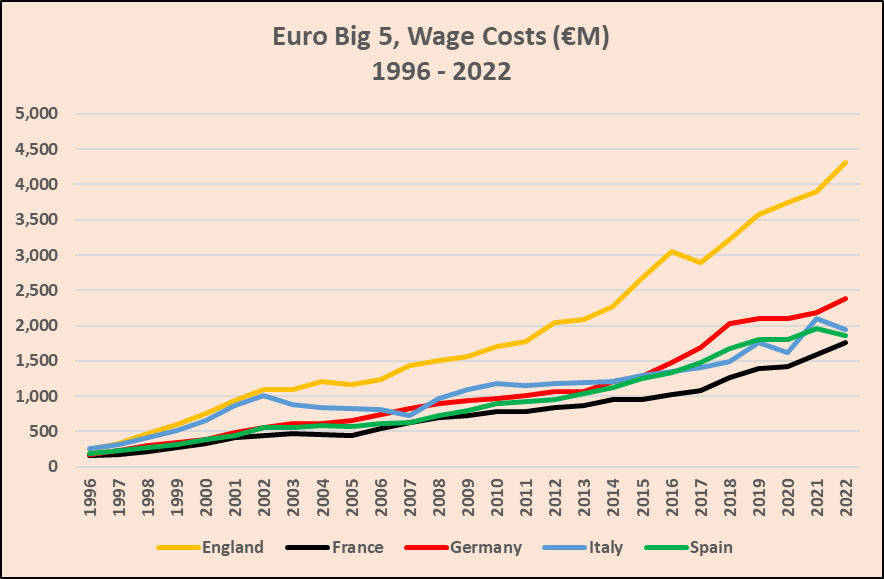
 The financial strength of the EPL allows their clubs to offer lucrative salaries and pay high transfer fees to attract the best players in the global football players’ labour market. As can be seen in Figure 2, the divergent revenue growth paths of the Big Five in Figure 1 are replicated in similar divergent wage growth paths. Effectively, the €3bn revenue advantage of the EPL in 2022 allowed EPL clubs to spend €2bn more on wage costs than the German Bundesliga, the next biggest spenders in the Big Five. And it is not just the best players that can be attracted to the EPL, it is also the best coaching and support staff. The danger of financial dominance in pro team sports is that it can lead to sporting dominance and this, in turn, can undermine the sustainability of the league as teams with less financial power seek to remain competitive by overspending on wages, leading to operating losses and increasing levels of debt.

Figure 2: Wage Costs (m), European Big Five, 1996 – 2022


The danger of overspending on wage costs relative to revenues can be seen very clearly in the wage-revenue ratio, possibly the most important financial performance ratio in pro team sports. By far the most dominant cost in any people business such as sport and entertainment is wages. If wage costs are too high relative to revenues, teams will make operating losses and will require to be either deficit-financed by their owners or debt-financed with all of the attendant risks. As can be seen in Figure 3, the wage-revenue ratios have tended to be highest in the French and Italian leagues, the smallest financially of the Big Five leagues. Indeed in the early 2000s the Italian Serie A got close to spending all of its revenue on wages, with the French Ligue 1 nearly emulating this during the Covid years.

Figure 3: Wage-Revenue Ratios, European Big Five, 1996 – 2022

Table 2 shows the danger of the financially smaller leagues having higher wage-revenue ratios. They can be put in a very precarious position if there is a sudden loss of revenues as happened during the pandemic (but could also happen if there is a loss in the value of a league’s media rights). Wage costs are largely fixed at any point in time through contractual commitments so any reduction in revenues is likely to lead to higher wage-revenue ratios and operating losses. As a benchmark, financial prudence would normally dictate wage-revenue under 65% in order to make operating profits. The French and Italian leagues operated with wage-revenue ratios above 70% prior to the pandemic and both remained above 80% in 2022. The Spanish La Liga was on a par with the EPL in 2019 at just over 60%. Both leagues saw their wage-revenue ratio rise above 70% in 2021 but, whereas the EPL fell back below 67% in 2022, La Liga remained high above 70%.

Table 2: Wage-Revenue Ratio, European Big Five, Selected Years

LeagueWage-Revenue Ratio
201920212022
England61.17%71.05%66.84%
France73.03%98.27%86.87%
Germany53.75%64.96%59.13%
Italy70.42%82.98%82.98%
Spain62.04%74.19%72.66%

In footballing terms, the bastion of football prudence has been the German Bundesliga with its longstanding financial management regime requiring clubs to submit budgets for approval as a condition of their league membership. As seen in both Figure 3 and Table 2, the Bundesliga has historically operated with wage-revenue ratios between 45% and 55%. Even with the loss of revenue during the Covid years, the wage-revenue ratio only hit 65% and fell back below 60% in 2022. The effectiveness of the German approach can be seen in Table 3 which reports the marginal wage-revenue ratio (MWRR) over the last 27 years. What this ratio shows is the proportion on average spent on wages of every increment of €1m of revenue over the last 27 years as each league has grown financially. The EPL has had a MWRR of 65.0% with the Spanish La Liga operating in a very similar way with a MWRR of 67.7%. The Bundesliga has had a MWRR of 56.5%. Given that the Spanish and German leagues are of a similar size in revenue terms, it suggests that long term the Germen financial management regime has lowered their wage-revenue ratio by 11% compared to what it would have been with a lighter touch. The very high MWRRs of the French and Italian leagues coupled with their lower revenue growth rates further reinforce the concerns over their financial future.

Table 3: Marginal Wage-Revenue Ratio, European Big Five, 1996 – 2022

LeagueMarginal Wage-Revenue Ratio 1996 – 2022
England65.03%
France83.21%
Germany56.60%
Italy79.31%
Spain67.73%

Notes:

  1. The raw financial data for the analysis has been sourced from various editions of Deloitte’s Annual Review of Football Finance (Annual Review of Football Finance 2023 | Deloitte Global)
  2. Throughout the years refer to financial year-end. Hence, for example, the figures reported for 1996 refer to season 1995/96.
  3. The base year of 1996 has been used since 1995/96 was the first season when the EPL adopted its current 20-club, 380-game format.
  4. Average league gates for season 2019/20 have been used to calculate Local Spend during the Covid years when games were played behind closed doors with no spectators in the stadia.

Financial Determinism and the Shooting-Star Phenomenon in the English Premier League

Executive Summary

  • Financial determinism in professional team sports refers to those leagues in which sporting performance is largely determined by expenditure on playing talent
  • Financial determinism creates the “shooting-star” phenomenon – a small group of ”stars”, big-market teams with the high wage costs and high sporting performance, and a large “tail” of smaller-market teams with lower wage costs and lower sporting performance
  • There is a very high degree of financial determinism in the English Premier League
  • Achieving high sporting efficiency is critical for small-market teams with limited wage budgets seeking to avoid relegation

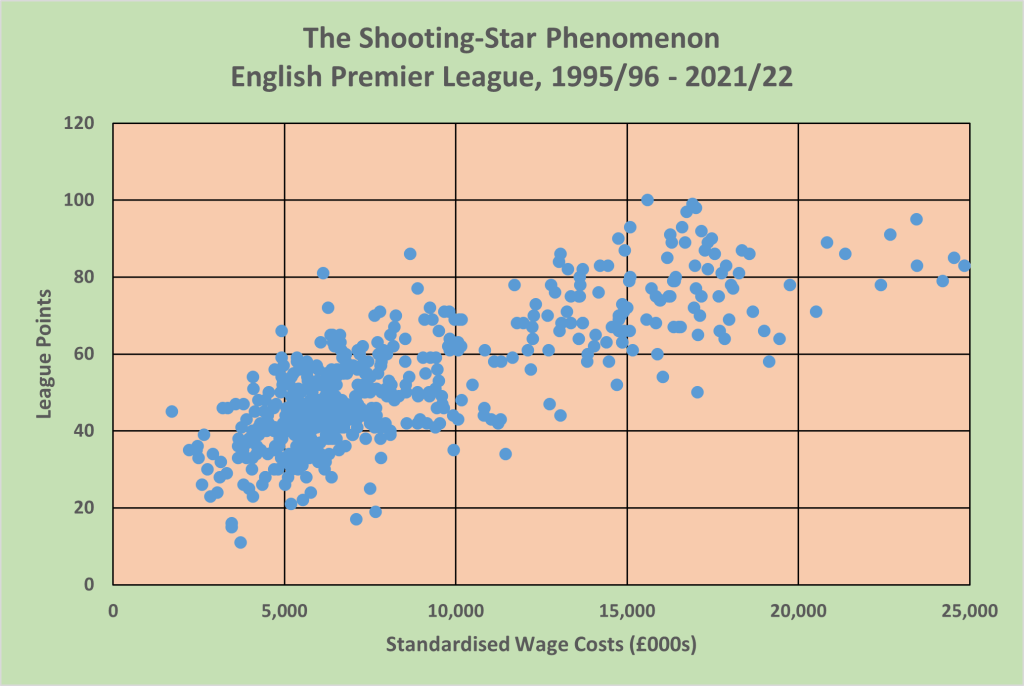
Financial determinism in professional team sports refers to those leagues in which sporting performance is largely determined by expenditure on playing talent. It is the sporting “law of gravity”. Financial determinism implies a strong win-wage relationship with league outcomes highly correlated with wage costs so that those teams with the biggest markets and the greatest economic power (i.e. the biggest “wallets”) to be able to afford the best players tend to win. Financial determinism creates what can be called the “shooting-star” phenomenon shown in Figure 1. The “stars” are the sporting elite in any league, the big-market teams with the high wage costs and high sporting performance. The rest of the league constitutes the “tail”, the smaller-market teams with lower wage costs and lower sporting performance. Some small-market teams can temporarily defy the law of gravity by achieving high sporting efficiency. The classic example of this is the Moneyball story in Major League Baseball where the Oakland Athletics used data analytics to identify undervalued playing talent. And, of course, there are the bigger market teams who spend big but do so inefficiently and perform well below expectation.

Figure 1: The Shooting-Star Phenomenon

A fundamental proposition in sports economics is that uncertainty of outcome is a necessary condition for viable professional sports leagues. This is the notion that the essential characteristic of sport is the excitement of unscripted drama where the outcome is determined by the contest and is not scripted in advance. Uncertainty of outcome requires that teams in any league are relatively equally matched in their economic power with similar revenues and similar access to financial capital. Unequal distribution of economic power across teams leads to financial determinism. The most common causes of disparities in economic power between teams are location (i.e. teams based in large metropolitan areas often have much bigger fanbases and, consequently, can generate much higher revenues) and ownership wealth (i.e. teams with rich owners who are driven by sporting glory rather than profit and will spend whatever it takes to win). To prevent financial determinism, leagues have used a number of regulatory mechanisms to maintain competitive balance including revenue sharing, salary caps and player drafts.

Is the English Premier League subject to financial determinism and the shooting-star phenomenon? To answer this question I have tracked wage costs reported in club accounts from 1995/96 onwards when the English Premier League adopted its current structure of 20 teams and 380 games with three teams relegated. Clubs are still in the process of reporting their 2023 accounts so that the analysis concludes with season 2021/22. Since the analysis covers 27 seasons, wage costs need to be standardised to allow for wage inflation. I have used average wage costs each season to deflate wage costs to 1995/96 levels.  Very roughly, £10m wage costs in 1996/97 equates to £200m wage costs in 2021/22. Sporting performance has been measured by league points based on match outcomes; any point deductions for breach of league regulations have been excluded. (Middlesbrough were deducted 3 points in 1996/97 for failing to fulfil a scheduled fixture and Portsmouth were deducted 9 points in 2009/10 for going into administration.) Figure 2 shows the scatterplot of league points and standardised wage costs. The two groupings, the big-spending stars and the lower-spending tail, are very obvious. The tail is very dense and contains most of the observations (73.9% of the clubs had standardised wage costs under £10m). The stars are fewer in number and more dispersed with 10 instances of clubs having standardised wage costs in excess of £20m (which equates to over £400m in 2021/22). The correlation between standardised wage costs and league points is 0.793 which implies that over the 27 seasons, 62.8% of the variation in league performance can be explained by the variation in wage costs. In other words, there is a very high degree of financial determinism in the English Premier League.

Figure 2: The Shooting-Star Phenomenon in the English Premier League

Season 2021/22 is very typical as regards the degree of financial determinism in the English Premier League as shown in Figure 3. The correlation between wage costs and league points is 0.793 which implies that 61.2% of the variation in league performance can be explained by the variation in wage costs. The linear trendline acts as a performance benchmark – the average efficient outcome for any given level of wage costs – and thus identifies above-average efficient (“above the line”) outcomes and below-average efficient, “below the line” outcomes. At the top end, Manchester City, the champions with 93 points, a single point ahead of Liverpool, were outspent by both Manchester United and Liverpool. Manchester United were highly inefficient gaining only 58 points but with wage costs of £408m. By comparison, West Ham United gained 56 points with wage costs of £136m.

Figure 3: Win-Wage Relationship in English Premier League, 2021/22

As regards relegation, all three relegated teams – Norwich City, Watford and Burnley – lie below the average-efficiency line. In the cases of both Burnley and Watford their final league positions matched their wage rank  – their sporting efficiency was not good enough to offset their resource disadvantage. In contrast, Norwich City allocated enough resource to avoid relegation – their wage costs of £117m ranked 15th – but they were highly inefficient. Of the lower spending teams, the two most efficient teams were Brentford and Brighton and Hove Albion who both finished safely in mid-table but ranked 20th and 16th, respectively, in wage costs. In a future post, I will analyse the determinants of sporting efficiency in more detail.

Read other Related Posts

League Gate Attendances in English Football: A Historical Perspective

Executive Summary

  • The historical trends in league gate attendances in English football can be powerfully summarised visually using timeplots
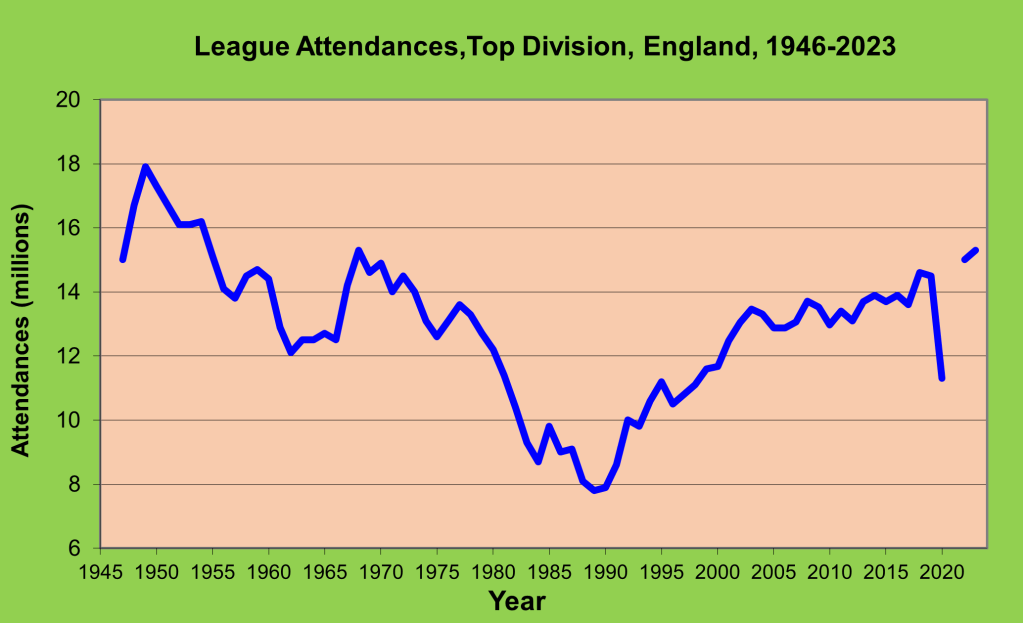
  • Total league attendances peaked in 1948/49 and thereafter declined until the mid-1980s
  • League attendances across the Premier League and Football League have recovered dramatically since the mid-1980s and are now at levels last experienced in the 1950s
  • Using average gates to allow for changes in the number of clubs and matches, the  Premiership matches in 2022/23 averaged 40,229 spectators per match, the highest average gate in the top division since the formation of the Football League in 1888 

How popular are the top four tiers of English league football as a spectator sport from a historical perspective? That’s the question that I want to address in this post using timeplots to visualise the historical trends in gate attendances. I have compiled a dataset with total league attendances for every season since the Football League began in 1888. To ensure as much comparability as possible, I have included only regular-season matches and excluded post-season play-off matches. (A historical footnote – post-season playoffs to decide promotion/relegation are not a modern innovation. There were playoffs called “test matches” in the early years of the Football League after the creation of the Second Division in 1892 but these were abandoned in 1898 and replaced by automatic promotion and relegation following  a scandal when Stoke City and Burnley played out a convenient goalless draw that ensured both would be promoted.)

Total league attendances for the top four divisions are plotted in Figure 1 with three breaks: 1915/16 – 1918/19 due to the First World War, 1939/40 – 1945/46 due to the Second World War and 2020/21 due to the Covid pandemic when all matches were played behind closed doors. In addition, total attendances dropped sharply in 2019/20 due to the final part of the season being postponed and the matches eventually played behind closed doors in the case of the Premier League and Championship, and cancelled entirely in League One and League Two.

Figure 1: Total League Attendances (Regular Season), England, 1888-2023

The Football League started in 1888 with a single division of 12 clubs. Preston North End were the original “Invincibles”, completing the League and FA Cup “Double” unbeaten in the inaugural season. A second division was formed in 1892 and membership of the Football League gradually expanded so that by the outbreak of the First World War in 1914 there were 40 member clubs split equally into two divisions with automatic promotion and relegation between the two divisions. Gate attendances peaked at 12.5 million in the 1913/14 season. The Football League expanded rapidly in the years immediately after the First World War with the incorporation of the Southern League as Division 3 in 1920 and the creation of a Division 3 (North) and Division 3 (South) the following years which increased the membership to 88 clubs by 1923. Total gate attendances reached 27.9 million in season 1937/38.

Gate attendances sharply increased after the Second World War, reaching a record 41.3 million in season 1948/49 which equated to around one million fans attending Football League matches on Saturday afternoons. Although the Football League expanded its membership to its current level of 92 clubs in 1950 and reorganised the two regionalised divisions into Division 3 and Division 4 in 1958, a long-term decline in attendances had set in with attendances falling steadily from the 1950s until the mid-1980s with the exception of a brief reversal of fortune in the late 1960s attributed to a renewed love of the beautiful game after England’s 1966 World Cup victory. The decline bottomed out in 1985/86 when Football League attendances fell to only 16.5 million which represented a 60.0% decrease from the peak in 1948/49. Thereafter the story has been one of continued growth, accelerated in part by the declaration of independence of the top division in 1992 with the formation of the FA Premier League. By last season (2022/23), league attendances in the top four tiers of English football had reached 34.8 million, a level last attained in season 1954/55 – quite an incredible turnaround.

The U-shaped pattern in total league attendances since the end of the Second World War is also evident but less clearly so if we focus only on the top division (see Figure 2). In particular, the post-1966 World Cup effect is much more noticeable with attendances rising from 12.5 million in 1965/66 to 15.3 million in 1967/68 and remaining above 14 million until 1973/74, and thereafter declining to a low of 7.8 million in 1988/89. Interestingly, given that league attendances in the top division account for 40% – 50% of total attendances for the top four divisions, it is somewhat anomalous that the recovery in attendances in the top division seems to have lagged around three years behind the rest of the Football League. However, part of the explanation is the changes in the number of clubs in the top division during that period. There were 22 clubs in the top division from 1919/20 to 1986/87 but this was reduced to 21 clubs in 1987/88 and 20 clubs in 1988/89 before returning to 22 clubs in 1991/92 with the current divisional structure of a 20-club Premier League and three 24-club divisions in the Football League dating from 1995.

Figure 2: League Attendances, Top Division, England, 1946-2023

Given the variations in the number of matches with spectators in the top division across time due to the changes in the number of clubs as well as the effects of the pandemic on total attendances in the 2019/20 season, it is more useful to compare average league gates (see Figure 3). The average gate at top division matches peaked at 38,776 in 1948/49 and declined to a low of 18,856 in 1983/84 (which leads the nadir of total Football League attendances by two years). The rapid growth in Premier League attendances occurred between 1993 and 2003 with the average gate of 21,125 in 1992/93, the first season of the Premier League, increasing by 67.8% over the next 10 years to an average gate of 35,445 in 2002/03. Growth has continued thereafter so that the average gate in the Premier League reached 40,229 in 2022/23, an historical high since the formation of the Football League and 3.7% above the previous record average gate set in 1948/49.

So to answer the question I posed at the start of the post – the top tier of English league football has never been more popular as measured by gate attendances on a per match basis, and the rest of the Football League has a level of popularity not experienced since the 1950s. England has rediscovered its love of the beautiful game since the mid-1980s and not just Premiership football. And that is before considering the explosive growth in TV coverage of English league football both domestically and internationally. But that, as they say, is another ball game entirely.

Figure 3: Average Gate, Top Division, England, 1946-2023