

The importance of competitive balance and uncertainty of outcome for professional sports leagues is axiomatic not only in academia but also within the sports industry and the media in general. But what is competitive balance? There are a multitude of definitions and metrics. Competitive balance clearly means different things to different people. Its importance is also problematic. The English Premier League (EPL) is often cited as an example of a competitively dominated league but its gate attendances and TV ratings continue to grow, as does the value of its domestic and international media rights.
I have long held an interest in competitive balance both as a sports economist and as a sports fan. I have presented at various academic and industry conferences and workshops on the subject over the years as well as publishing journal articles and book chapters. Much of my research on competitive balance has been in collaboration with Morten Kringstad, a Norwegian sports economist who completed a doctoral dissertation on competitive balance at Leeds University Business School
In this post I want to discuss competitive balance in terms of four issues – definition, significance, measurement and implications. In two subsequent posts I will present empirical evidence on competitive balance in both European football and the North American major leagues that Morten and I have published in recent journal articles.
Definition
What is competitive balance? In the most general sense, competitive balance is the distribution across teams of the probability of sporting success in a league. (Although my focus is primarily with competitive balance in professional teams sports in which teams compete in a league-structured tournament, competitive balance can apply to both individual and team sports and to both league and elimination tournaments.) Perfect competitive balance implies that all teams in a league have an equal probability of sporting success. This, in turn, would require an equal distribution of playing and coaching talent across all teams. Competitive dominance (i.e. competitive imbalance) implies that a small number of teams in a league have high probabilities of sporting success with all the other teams having close to zero probability of sporting success.
Significance
Why is competitive balance important? Sports economists have long argued that uncertainty of outcome is a necessary requirement for the financial viability of professional sports leagues. Sporting contests are unscripted drama in which there is no need for the audience to suspend their belief to create uncertainty over the outcome. But teams vary in their economic power as a matter of history and geography. Teams located in large metropolitan areas have a larger potential local fanbase. Fans from outside the team’s local catchment area are often attracted by a team’s current success. The bigger a team’s fanbase, the bigger its potential economic power to monetise its sporting operations through gate receipts, corporate hospitality, merchandising, sponsorship and media rights. There is also the possibility of non-indigenous economic power through the acquisition of the team by a wealthy ownership. The constant threat is a league may become competitively dominated by a small group of very economically powerful teams, possibly just one “super” team, so that there is no longer any real uncertainty of outcome leading to a loss of general engagement with the league and the consequent decline in revenues.
Measurement
How is competitive balance measured? Competitive balance is an ex ante concept in the sense that it refers to expected sporting outcomes. Competitive balance is most appropriately measured by betting odds or the actual distribution of playing and coaching resources (or the financial resources available to teams to spend on their sporting operations). Within the academic literature, the empirical focus has typically been on ex post competitive outcomes i.e. the distribution of actual sporing performance across teams.
As I indicated in my introductory remarks, one of the main problems in the research on competitive balance is the large number of alternative metrics. One of main themes of my research, particularly my collaboration with Morten Kringstad, has been to construct a classification system to bring some order to the chaos of the multiple competitive balance metrics. Essentially competitive balance metrics can be classified in terms of two dimensions – timeframe and scope. As regards the timeframe, competitive balance metrics can be grouped into those focused on competitive balance in a single season and those that focus on multiple seasons. Single-season metrics are termed “win dispersion” and seek to measure the distribution of sporting outcomes across teams in one league season. The original formulation of this metric is the relative standard deviation (RSD) which measures the actual standard deviation of team win percentages as a ratio of the standard deviation for an ideal league of the same size in which every team has a 50-50 chance of winning every game (statistically this ideal league is modelled as a binomial distribution with match outcomes treated as equivalent to a fair coin toss). Multiple-season measures are termed “performance persistence” and measure the extent to which teams replicate the same level of performance across seasons. One widely used measure of performance persistence is the rank correlation of league positions of teams in successive seasons.
Win dispersion and performance persistence represent different aspects of competitive balance – is a league characterised in each season by teams being closely grouped together with similar win-loss records (i.e. low win dispersion)? do the same teams tend to finish towards the top/middle/bottom of the league every season (i.e. high performance persistence)? Win dispersion and performance persistence are not the same thing and it is not clear which is more important in driving gate attendances and TV ratings. And win dispersion and performance persistence need not necessarily move together over time. (The dispersion-persistence relationship is a particular focus of the empirical evidence to be presented in subsequent posts on competitive balance.)
The scope dimension refers to whether the competitive balance metrics are calculated for the whole league using the sporting outcomes of all teams (whole-league metrics) or are focused on just the top and/or bottom of the leagues (tail-outcome metrics). One widely reported tail-outcome metric is the concentration of league championship titles. Other tail-outcome metrics include those measuring the concentration of play-off qualification and, in merit-hierarchy leagues, the frequency with which newly-promoted teams are relegated.
It is easy to see why there is such a multiplicity of competitive balance metrics. Not only are there differences in timeframe and scope, there are also differences in the how dispersion, persistence and concentration can be defined formally. For example, dispersion has been defined using standard deviation, degree of inequality, entropy and distribution shares. Also many measures are calculated relative to some concept of perfect/maximum competitive balance and/or perfect competitive dominance which, in turn, can be defined in various ways. In addition, real-world leagues differ in their size and structure, requiring adjustments to standard metrics to ensure comparability across leagues.
Implications
What are the implications of competitive balance for leagues? As previously suggested, it is widely believed that professional sports leagues can only remain economically viable if they maintain a degree of competitive balance. However, what exactly this means in practical terms is far from clear. There is a multiplicity of competitive balance metrics and no definitive empirical evidence on the extent to which win dispersion and/or performance persistence influences gate attendances and TV ratings. But what is understood is that ultimately the principal driver of competitive balance is the distribution of playing talent between teams.
Figure 1: The Drivers of Competitive Balance
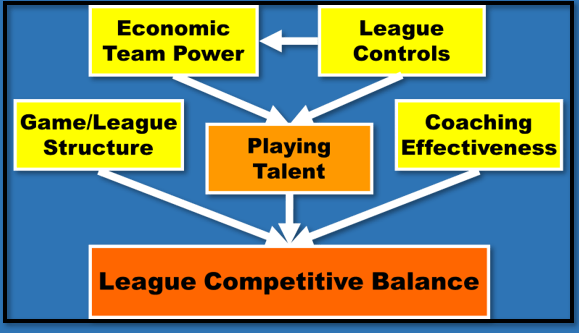
Leagues have used a variety of regulatory mechanisms to try to equalise the distribution of playing talent between teams. These regulatory mechanisms can be broadly categorised as direct or indirect controls. Direct controls operate directly on the player labour market and seek to prevent the economically more powerful teams from cornering the market for the best players by outbidding smaller teams in the salaries offered. Direct controls limit either how much teams can spend on playing talent (e.g. salary caps) or restrict the extent to which playing talent is allocated between teams by the market mechanism (e.g. draft systems). Indirect controls try to equalise the economic power of teams by some form of revenue redistribution. Traditionally this was done by sharing gate receipts but in recent years leagues have used the allocation between teams of the revenues from the collective selling of league media and sponsorship rights.
Other Related Posts
Financial Determinism and the Shooting-Star Phenomenon in the English Premier League
 Winning With Analytics
2 thoughts on “Competitive Balance Part 1: What Are The Issues?”